Finding a router that covers every corner of a busy home can be a challenge. The following selections emphasize strong range, robust Wi‑Fi 6/6E performance, and reliable multi‑device handling. Each product below is tailored for homes that demand wide coverage, smooth streaming, gaming, and smart‑home stability. This guide highlights five routers that balance range with speed across typical large living spaces, multi‑story houses, and home offices.
Summary of chosen products:
- TP-Link AXE5400 Tri-Band WiFi 6E Router (Archer AXE75) – Strong 6E range with a new 6 GHz band for dense networks.
- TP-Link AX6000 Wi-Fi 6 Router (Archer AX80) – Excellent overall range with 2.5 Gbps wired option.
- TP-Link Archer BE6500 Dual‑Band Wi‑Fi 7 Router (BE400) – Future‑ready, wide coverage for many devices.
- TP-Link AX5400 WiFi 6 Router (Archer AX73) – Long‑range dual‑band performance for streaming and gaming.
- NETGEAR 4‑Stream WiFi 6 Router (R6700AX) – Reliable coverage for mid‑to‑large homes with easy setup.
TP-Link AXE5400 Tri‑Band WiFi 6E Router (AXE75)

Core specs emphasize a three‑band layout with a new 6 GHz channel, designed to handle high‑demand devices and simultaneous 4K/8K streaming, gaming, and video calls. The AXE75 supports 6 GHz, 5 GHz, and 2.4 GHz bands, delivering up to 5400 Mbps combined. It’s built for more responsive multiplayer gaming and smoother conferencing thanks to the newly allocated spectrum. OFDMA and MU‑MIMO help distribute bandwidth efficiently across many devices, while VPN and WPA3 security keep connections protected. The router also supports OneMesh for expanding coverage with compatible TP‑Link devices.
TP-Link AX6000 Wi‑Fi 6 Router (Archer AX80)
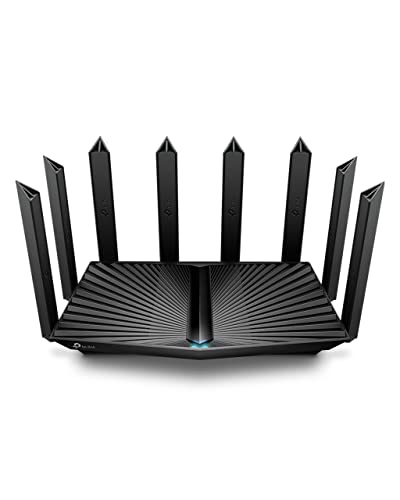
With dual‑band Wi‑Fi 6 and a 2.5G multi‑gigabit WAN/LAN port, the AX80 is designed to cover larger homes with reliable throughput. It leverages eight high‑gain antennas and Beamforming to focus signals toward connected devices, boosting range and consistency in challenging layouts. MU‑MIMO and OFDMA further improve efficiency when many devices share the network. The AX80’s aggressive feature set aims to minimize latency during gaming and 4K/8K streaming across multiple rooms.
TP-Link Archer BE6500 Dual‑Band Wi‑Fi 7 Router (BE400)

Be400 represents a future‑ready Wi‑Fi 7 option with dual‑band operation, designed to cover homes up to 2,400 square feet and support up to around 90 devices. The architecture includes Multi‑Link Operation and advanced modulation to maximize throughput and coverage. WPA3 Security, Private IoT, and HomeShield contribute to a safer smart home environment. The BE6500 targets large households with many connected devices, offering strong range and improved network efficiency for latency‑sensitive tasks.
TP-Link AX5400 Wi‑Fi 6 Router (Archer AX73)

The AX73 balances range and speed with 5 GHz and 2.4 GHz bands powered by Wi‑Fi 6 technology. It’s designed to handle high‑definition streaming, gaming, and downloads across multiple rooms. OFDMA and MU‑MIMO help minimize congestion as device counts rise, while Beamforming improves signal directionality to extend coverage within larger homes. The AX73 provides a solid mix of performance and range for many multi‑room setups.
NETGEAR 4‑Stream WiFi 6 Router (R6700AX)

The R6700AX delivers AX1800 performance with dual‑band coverage suitable for mid to large homes. Its four‑stream design supports multiple devices for streaming, gaming, and conferencing with reliable throughput. It’s a straightforward option for households that want dependable range without extra complexity. A separate modem is required for most service plans, and the router focuses on wide coverage and stable connections rather than premium multi‑room mesh features.
Buying Guide: Key Purchase Considerations
- Coverage area: Check recommended square footage and the number of walls or floors the router claims to cover. For larger homes, tri‑band or Wi‑Fi 7 options can provide more even coverage.
- Band technology: Wi‑Fi 6, 6E, and 7 differ in spectrum and throughput. 6E adds the 6 GHz band for less congestion, which benefits dense networks and high‑demand devices.
- Wired options: Look for multi‑gig or 2.5 Gbps WAN/LAN ports on routers intended for fiber or high‑speed cable service to avoid bottlenecks.
- Device density: If you have many IoT devices, MU‑MIMO and OFDMA help distribute bandwidth efficiently. For gaming, prioritize low latency and stable connections.
- Mesh compatibility: If covering a very large home, consider mesh or OneMesh ecosystems to extend coverage with multiple units.
- Security features: WPA3, VPN support, and built‑in threat protection (like HomeShield) add layers of protection for home networks.
- Setup and support: Some brands offer robust setup guides, mobile app control, and expert support, which can reduce installation time and troubleshooting.
The selections above present a spectrum of range and performance across popular TP‑Link and NETGEAR models. Each option caters to different home layouts and device loads, helping you balance wide coverage with high performance for everyday use and entertainment.