The right guitar tuner helps players of all levels stay in perfect pitch, whether on stage, in the studio, or at practice. This guide highlights five top clip-on tuners designed for guitar, bass, and other stringed instruments, focusing on accuracy, visibility, quick tuning, and versatility. Each pick is evaluated on vibration sensing, display readability, and ease of use across environments.
| Product | Brand | Key Strengths |
|---|---|---|
| Snark SN5X Clip-On Tuner | SNARK | 360° display, universal instrument support |
| Fender FCT-2 Multi-Instrument Tuner | Fender | Vibration sensing, multi-instrument modes |
| New Bee Clip-On Tuner | New Bee | Color screen, 360° rotatable, multiple tunings |
| D’Addario Nexxus 360 | D’Addario | Rechargeable, 24-hour runtime, 360° view |
| TC Electronic PolyTune Clip | TC Electronic | Polyphonic tuning, bright display |
Snark SN5X Clip-On Tuner for Guitar, Bass & Violin

The Snark SN5X is a versatile clip-on tuner designed to stay securely in place on acoustic, electric, bass, and violin headstocks. Its “Stay Put” clip is engineered to grip firmly without slipping, while a 360-degree rotating display lets players find an optimal viewing angle whether seated or standing. The tuner supports multiple instrument types, simplifying switching between guitars and other stringed instruments during rehearsals or performances. With quick pitch detection and a bright display, tuning is fast and distraction-free in loud environments.
Fender FCT-2 Professional Multi-Instrument Clip-On Tuner

The Fender FCT-2 is built for reliability in varied performance settings. It detects tuning vibrations from the instrument, delivering accurate results in loud venues or quiet practice rooms. Its visual feedback uses a clear color LCD needle display that quickly guides you toward center pitch, enabling faster tuning with less visual distraction. This tuner includes dedicated modes for Guitar, Bass, Ukulele, Violin, and Chromatic tuning, making it a flexible option for players who string different instruments or collaborate with others on diverse setups.
New Bee Clip-On Rechargeable Tuner with Color Screen

The New Bee tuner features a vivid high-resolution color display for clear visibility in any lighting. It supports tuning for guitar, bass, ukulele, violin, cello, and more, with auto-detect tuning for guitar and a 360° rotatable screen for flexible viewing. A silicone-padded clamp grips securely without risking instrument damage, making it suitable for stage use, practice, and studio sessions alike. This model emphasizes a user-friendly interface and broad instrument compatibility in a single compact device.
D’Addario Nexxus 360 Rechargeable Guitar Tuner
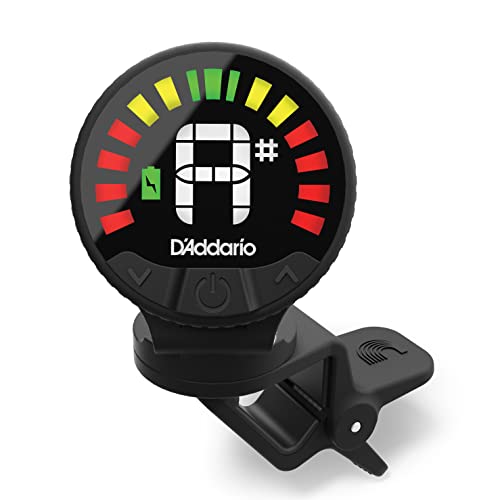
The Nexxus 360 offers quick tuning with a large screen and a clamp that rotates 360 degrees for varied viewing angles. It is rechargeable, providing up to 24 hours of tuning per charge, reducing ongoing costs and battery waste. Its wide calibration range (415-465Hz) supports precise performance across standard concert and practice settings. The device emphasizes speed, reliability, and longevity for players who tune frequently and on the go.
TC Electronic PolyTune Clip

The TC Electronic PolyTune Clip stands out with its polyphonic tuning capability, enabling tuning all six strings simultaneously for rapid setup. It also offers chromatic and precise strobe modes with an 108-LED matrix display for clear readouts in any stage or studio setup. The ultra-bright display and adaptive readout ensure reliable performance regardless of the instrument’s orientation or lighting, making it a strong choice for performers who prioritize speed and accuracy on the clock.
Buying Guide
Key purchase considerations when selecting a guitar tuner:
- Display visibility: Look for bright, high-contrast displays and color cues that are easy to read on stage or in dim practice spaces.
- Sensor method: Clip-on tuners that sense vibration tend to perform better in noisy environments than microphone-based models.
- Rotation and positioning: Models with 360-degree rotatable displays or flexible mounting help accommodate left-handed players and different headstock angles.
- Instrument versatility: If you play multiple stringed instruments, a multi-instrument or chromatic tuner can reduce gear clutter.
- Power options: Rechargeable batteries offer convenience and cost savings, while replaceable batteries simplify field use.
- Calibration range: A wide calibration range (e.g., 410–480 Hz) provides more accurate tuning across tunings and tunable standards.
- Form factor and durability: A compact, clip-on design minimizes weight and reduces the risk of damage during travel or performances.
Comparison considerations:
- Speed vs. precision: Some tuners prioritize rapid detection and sweeping capability, while others emphasize micro-tuning accuracy (strobe modes).
- All-in-one vs. instrument-specific: If you only play guitar, a standard clip-on may suffice; for players with multiple instruments, a multi-instrument model can save space and money.
- Display orientation: Vertical vs. horizontal screens can affect readability from different angles; choose based on your typical playing position.
For best results, check user reviews for real-world performance in your typical environment—particularly if you frequently play in loud venues or crowded practice spaces. When selecting, prioritize models with flexible viewing angles, strong vibration sensing, and a display that remains legible under stage lighting.