Finding reliable wildlife trail cameras requires balance between image quality, battery life, field durability, and practical connectivity. The following selection highlights five standout options that perform well in varied outdoor conditions, from dense forests to open fields. Each model supports high-resolution stills or video, weather resistance, and remote viewing capabilities where applicable, helping researchers, hikers, and property owners observe wildlife with minimal disturbance.
Summary of chosen products
| Product | Brand | Key Strength | Connectivity | Resolution |
|---|---|---|---|---|
| SEHMUA 3rd Cellular Trail Camera | SEHMUA | High-resolution images and 2K video with solar power | Cellular with built-in SIM | 48MP / 2K |
| SPYPOINT Flex-M Twin Pack | SPYPOINT | Dual-sim LTE, free photo transmission plan | Cellular | 28MP / 720p |
| VIDVIS Trail Camera | VIDVIS | 4K video, 64MP photos, solar power option | Wifi/Bluetooth via hotspot | 4K / 64MP |
| GardePro E6 Trail Camera | GardePro | 48MP stills, 1296P video, wide angle | Wi-Fi | 48MP / 1296P |
| MAXDONE Trail Camera | MAXDONE | 4K video, 64MP photos, detachable solar | WiFi + Bluetooth (hotspot) | 4K / 64MP |
SEHMUA 3rd Cellular Trail Camera
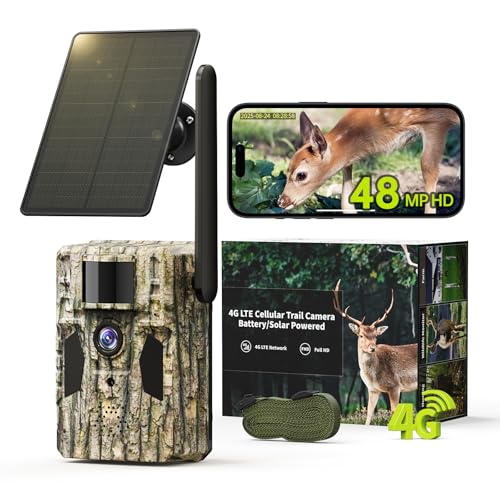
The SEHMUA trail camera offers 48MP stills and 2K video, delivering evidence-grade visuals suitable for wildlife observation. It features a 940nm no-glow infrared LED for nighttime capture without disturbing targets, and a robust IP66 weatherproof rating for harsh environments. A built-in 4W solar panel supports long-term field use while the large 7800mAh battery reduces maintenance. Solar operation helps observers track wildlife across seasons, from nocturnal activity to daytime behavior.
Key capabilities include color night vision under ambient light, powered by the SC235 image sensor for clearer nocturnal visuals, and reliable performance in remote locations thanks to self-contained solar power. The built-in SIM enables cellular data transmission for remote viewing, making it suitable for remote wildlife study or property surveillance where constant access is needed.
DEATTI Trail Camera 48MP 4K Game Camera

DEATTI’s camera delivers 48MP photos with 2160P (4K) video and features a built-in WiFi/Bluetooth system for remote control via a mobile app. It operates as its own hotspot, removing traditional Wi-Fi network dependencies, which can simplify field setups. The package includes eight batteries and a 32GB SD card, and the device emphasizes quick triggering and nighttime visibility, with waterproof construction designed to endure outdoor conditions.
GardePro E6 Trail Camera

The GardePro E6 emphasizes connectivity with a dedicated app and a reliable antenna for stronger Wi-Fi signaling. It captures 48MP stills and 1296P video with a 110° wide view, providing broader field coverage. No monthly fees are required for the app-based operation, and the camera’s weather-sealed body ensures durability in diverse climates. This model is suited for scouting, property security, and wildlife monitoring where quick access to live previews is valuable.
MAXDONE Trail Camera

MAXDONE pairs 4K video with 64MP stills and a detachable solar panel for flexible charging in sunlit environments. The 6000mAh battery supports extended use, while the IP66 rating shields the unit from dust and moisture. The camera connects via WiFi/Bluetooth to the TrailCamGO app, enabling direct transfers to a smartphone. It also supports independent solar charging, making it suitable for long-term wildlife surveys without frequent battery changes.
Buying Guide
Key considerations for selecting an outdoor wildlife camera include image and video quality, triggering speed, and detection range. For nocturnal wildlife, models with no-glow infrared help minimize disturbance, while color night vision provides more detailed night images. Battery life and solar charging capabilities are critical for remote sites where maintenance is difficult. Wireless connectivity, whether cellular, Wi-Fi, or hotspot-based, offers real-time monitoring but may require data plans or hotspot setups. IP ratings (IP66 or higher) indicate durability against rain, dust, and temperature fluctuations.
Other factors to weigh are field of view and trigger speed: a wide aperture and a fast 0.2–0.5 second trigger time can capture more moments as animals move through the scene. Storage options (SD card capacity) and app usability influence long-term efficiency. Some cameras function as their own hotspot, which is advantageous in locations lacking stable home Wi-Fi. If you prefer remote monitoring with minimal on-site maintenance, solar-powered units with large battery banks deliver the most dependable field performance.
Connectivity approach varies by user needs. Cellular models provide remote access with varying data plans and transmission speeds, while Wi-Fi-based units excel in proximity to a base network. For property security alongside wildlife observation, a camera with robust night vision, weather sealing, and flexible mounting options offers multi-season reliability. Finally, consider whether you value turnkey kits with batteries and memory cards or prefer cameras that maximize solar charging and long-term power efficiency.