Finding the right oscilloscope for hobby projects means balancing bandwidth, sampling rate, size, and ease of use. This guide highlights popular handheld and benchtop options that cater to makers, students, and hobbyists. Each choice features practical specifications, portability, and value for entry-level to intermediate users. Explore our picks to identify a device that fits your project needs, from simple waveform viewing to more advanced signal analysis.
| Product | Brand | Bandwidth | Sampling Rate | |
|---|---|---|---|---|
| FNIRSI DSO152 Oscilloscope | FNIRSI | 200 kHz | 2.5 MS/s | Portable, pocket-friendly, basic triggers |
| Siglent SDS1202X-E | Siglent | 200 MHz | 1 GSa/s | Two-channel, feature-rich, solid performance |
| Hantek DSO2C10 | Hantek | 100 MHz | 1 GSa/s | Cost-effective with multiple triggers |
| FNIRSI 1013D Plus | FNIRSI | 100 MHz | 1 GSa/s | 2-channel, built‑in memory, DDS generator |
| FNIRSI DPOS350P | FNIRSI | 350 MHz | 1 GSa/s | 4-in-1: scope, DDS, spectrum analyzer, frequency response |
FNIRSI DSO152 Oscilloscope

The FNIRSI DSO152 is a compact handheld oscilloscope with a real-time sampling rate of 2.5 MS/s and a 200 kHz bandwidth. It ships with a 10× probe that can measure up to 800 VPP, making it suitable for a range of hobby projects and educational experiments. It features full trigger functions (AUTO, Normal, Single) for both periodic analog and aperiodic digital signals. The 2.8-inch color LCD (320×240) offers clear visibility, and its pocketable form makes it ideal for field work or classroom demos. This kit comes assembled, reducing setup time for beginners.
Siglent SDS1202X-E 200 MHz Oscilloscope
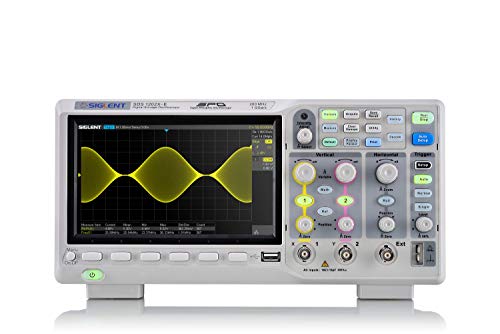
The Siglent SDS1202X-E offers a significant upgrade in performance with 200 MHz bandwidth and two channels. It supports real-time sampling up to 1 GSa/s and can handle long record lengths for thorough signal analysis. The interface is designed for ease of use, enabling quick setup of triggers and cursors. While priced as a mid-range option, it is well-suited for hobbyists pursuing more demanding projects or learning advanced measurement techniques in electronics and embedded systems.
Hantek DSO2C10 Digital Storage Oscilloscope

The Hantek DSO2C10 provides 100 MHz bandwidth and 1 GSa/s, packaged as a cost-conscious option for beginners and educators. It supports diverse trigger modes and basic serial protocol triggers, enabling straightforward debugging of microcontroller projects and simple communications gear. Its versatility makes it a practical choice for classroom labs and home tinkering where budget matters without sacrificing essential features.
FNIRSI 2C53T Upgraded Handheld Oscilloscope

The 2C53T is an upgraded handheld oscilloscope with 50 MHz bandwidth and 250 MSa/s sampling rate across two channels. It adds math operations, cursor measurement, persistence mode, and XY mode, broadening its utility for learning and prototyping. It supports waveform image storage and export, and includes a robust multimeter section (AC/DC voltage, current, resistance, capacitance) up to 9999 counts, making it a versatile toolbox for hobbyists and educators.
FNIRSI 1013D Plus Oscilloscope

The FNIRSI 1013D Plus is a portable, handheld two-channel oscilloscope with 100 MHz bandwidth and 1 GSa/s sampling. It supports single/normal/automatic triggering for both periodic and aperiodic signals. A 7-inch TFT LCD with 800×480 resolution keeps visuals sharp, and the built-in 6000 mAh battery allows several hours of field use. It includes waveform image storage and a generous 1 GB of onboard waveform data management, useful for note-taking and progression tracking.
FNIRSI DPOS350P 4-in-1 Tablet Oscilloscope

The FNIRSI DPOS350P combines oscilloscope functionality with a spectrum analyzer and a DDS generator, plus a frequency response analyzer in a handheld tablet form factor. With a 350 MHz bandwidth, 1 GSa/s sampling, and a 7″ touchscreen, it supports advanced signal analysis, EMI checks, and Bode-plot style measurements. It is suitable for more complex hobby projects, professional-grade tinkering, and field diagnostics where portability is essential.
Buying Guide
- Bandwidth vs. voltage needs: Higher bandwidth supports faster signals and cleaner edge capture. For most hobby projects, 100–200 MHz covers a wide range of common signals; consider 350 MHz if you work with RF or fast digital signals.
- Sampling rate and memory: A higher sampling rate reduces aliasing and improves waveform fidelity. Long memory depth enables longer view windows for complex signals; two-channel models are often enough for basic troubleshooting.
- Triggering and measurement features: Look for AUTO, Normal, and Single triggers, plus cursors, math functions, and built-in measurements. Some devices offer DDS generators or spectrum analysis as value adds.
- Portability vs. display: Handheld and tablet-style scopes are convenient for field work, while benchtop units typically provide larger screens and stable workflows. Battery life is important for on-site use.
- Storage and data handling: Built-in memory, waveform image export, and USB data transfer simplify documentation and sharing of results with peers or instructors.
- Probes and safety: Ensure probes suit the voltage levels you measure. Some models include high-voltage protection and safe voltage ranges suitable for hobby electronics and education.
- Software and updates: Brands that provide regular firmware updates and active user communities can extend the instrument’s usefulness over time.
- Budget and future needs: Start with essential features for beginners, then plan for upgrades (bandwidth, dual channels, and advanced triggers) as skills grow.
These options cover a range of hobbyist needs—from compact field-ready models to more capable benchtop devices with rich measurement features. When selecting, balance immediate project requirements with potential expansion into more demanding experiments, ensuring the instrument remains a long-term asset in your electronics toolkit.