Choosing the right microphone can dramatically improve audiobook narration, delivering clear voice, natural tone, and minimal room noise. This guide highlights five reliable options suitable for American readers and home studios. Each pick balances ease of use, sound quality, and compatibility across USB and XLR setups. Below is a quick summary of the featured products to help you compare at a glance.
| Product | Brand | Connection | Notable Strength |
|---|---|---|---|
| FIFINE Studio Condenser USB Microphone Kit | FIFINE | USB | All-in-one kit with boom arm, pop filter, and cable |
| Logitech for Creators Yeti USB Microphone (Blackout) | Logitech for Creators | USB | Multiple pickup patterns and real-time monitoring |
| MAONO AU-A04 USB/XLR Cardioid Condenser Mic Kit | MAONO | USB/XLR | Dual-mode flexibility with professional chipset |
| TroyStudio Portable Vocal Booth | TroyStudio | USB | Effective room treatment in a foldable enclosure |
| FIFINE AM8 USB/XLR Dynamic Microphone | FIFINE | USB/XLR | Dynamic capsule with mute, RGB, and USB convenience |
FIFINE Studio Condenser USB Mic Kit
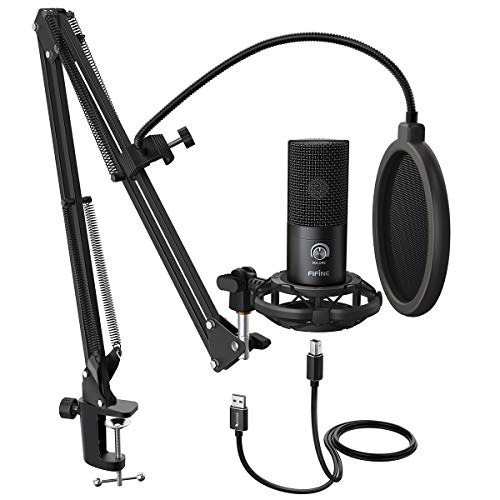
The FIFINE T669 is a complete USB condenser microphone kit that aims at simplicity and solid sound for voice work. Its cardioid capsule focuses on the front while reducing room noise, making it suitable for home studios and small podcast setups. The included desktop boom arm, shock mount, double pop filter, and lengthy USB cable help minimize desk noise and popping sounds during narration. While it’s designed for PC and laptop use, it’s not compatible with Xbox or phones, aligning with typical computer-based audiobook workflows.
Key features include a straightforward USB connection that supports plug-and-play recording, a sturdy arm setup for flexible positioning, and a two-layer pop filter system to dampen plosives. The kit’s rugged build supports consistent performance across long recording sessions. For readers seeking an all-in-one solution that reduces setup time, the FIFINE T669 offers a balanced blend of convenience and vocal clarity.
In practice, this mic excels for direct voice capture with minimal post-processing needs. It is well-suited for audiobook chapters delivered in a clear, neutral tone and is particularly effective in untreated home rooms where strategic mic placement and pop filters can counteract room reflections.
Logitech for Creators Blue Yeti USB Microphone

The Yeti from Logitech for Creators provides versatile recording options with multiple pickup patterns. For audiobook work, the cardioid setting is a robust choice, delivering focused voice pickup with natural presence. Studio controls for headphone volume, pattern selection, mute, and mic gain enable on-the-fly adjustments to maintain consistent vocal levels. A 3.5 mm headphone jack ensures real-time monitoring without latency, which helps narrators detect voice dynamics and timing during takes.
Its ergonomic design and broad compatibility make it a strong all-around option for aspiring voice actors and serious hobbyists. While it’s not a dedicated podcast mic, its flexibility and durable construction support long sessions and a variety of vocal styles. Users should consider a sound-treated space or acoustic treatment to further reduce room reflections for audiobook-grade recordings.
MAONO AU-A04 USB/XLR Condenser Kit

The MAONO AU-A04 offers dual-mode USB and XLR outputs, appealing to readers who want an easy USB setup or the option to upgrade to a more complex studio chain with mixers or audio interfaces. Its professional sound chipset sustains a high-resolution 192 kHz/24-bit sampling rate with a smooth frequency response, aiding clear vowels and crisp consonants essential for narration. The mic’s 16 mm transducer and magnet ring help minimize interference, while the included USB cable minimizes noise pickup.
The kit’s plug-and-play design supports rapid setup and broad OS compatibility. For audiobook work, the MAONO AU-A04 provides flexibility for future upgrades and a dependable, high-fidelity raw capture that can be refined with minimal post-processing. It is a practical choice for readers who want a step-up path from basic USB microphones without sacrificing simplicity.
TroyStudio Portable Vocal Booth

The TroyStudio portable vocal booth provides a compact, foldable solution to reduce room reflections. Its 2-inch-thick dense egg-crate foam panels are designed to absorb echo and reverberation, producing drier, more controlled vocal recordings. The booth supports various studio equipment, with interior dimensions supporting typical mic stands and microphones. The design is optimized for travel and quick setup, and the foldable structure helps keep a home studio organized.
From a sonic perspective, this booth improves clarity by isolating the voice from ambient noise. It is particularly effective for narrators who record in less-than-ideal rooms or apartments. While not a complete recording solution by itself, pairing the booth with a good USB or XLR microphone can yield noticeably crisper audiobook tracks with reduced post-processing needs.
FIFINE AM8 USB/XLR Dynamic Microphone

The FIFINE AM8 is a dynamic microphone designed for podcasting and streaming, available in USB and XLR configurations. Its dynamic capsule helps reject ambient noise and room echoes, which can be advantageous in untreated spaces. Features include an RGB light and a mute button for quick privacy during live sessions, as well as a headphone jack for zero-latency monitoring. The USB option simplifies setup for new narrators, while XLR support makes it easier to scale up to a pro-grade interface or mixer.
For audiobook work in noisy environments, the AM8’s dynamic design can be a practical choice, reducing pickup of room-related artifacts. Narrators who frequently record in shared spaces may appreciate its built-in monitoring controls and tactile mute switch to maintain consistent delivery across takes.
Buying Guide: Key Considerations for Audiobook Microphones
- Microphone type: Condenser mics capture a wide frequency range and are common for studio voice work, but room noise matters. Dynamic mics resist background noise better, which can be advantageous in non-studio environments.
- Connection method: USB mics offer plug-and-play simplicity; XLR mics require an audio interface or mixer but enable greater control and upgrade paths.
- Pickup pattern: Cardioid patterns prioritize sound from the front and reduce side and rear noise, helping with consistent narration. Multi-pattern mics offer flexibility for other uses but may complicate setup for audiobook work.
- Acoustic treatment: A quiet space and basic absorption (such as a portable booth or foam panels) can dramatically improve clarity and minimize post-processing time.
- Monitoring: Real-time headphone monitoring helps manage timing, breaths, and tone. Look for a dedicated headphone jack or integrated monitoring features.
- Pop filtering and proximity: A pop filter and proper mic placement prevent plosives and reduce sibilance. Distance guidelines (typically 2–6 inches) help maintain consistent volume and tone.
- Upgrade path: If you start with USB, ensure the option to move to XLR later without changing the entire chain. Dual-mode mics provide flexibility for future needs.
- Durability and ergonomics: A sturdy stand, shock mount, and boom arm reduce handling noise and improve workflow during long narration sessions.
Overall, the best microphone for audiobook recording depends on your workspace, budget, and long-term plans. USB kits with built-in treatment can deliver fast results for beginners, while XLR-based setups offer expanded control for professional studios. A combination of a capable mic, reliable monitoring, and basic acoustic treatment typically yields the most efficient path to crisp, engaging narration.