Choosing an indoor air quality monitor helps you track pollutants, optimize comfort, and safeguard health at home, at work, or in shared spaces. The following picks cover a range of sensors, battery life, and alert options to suit different environments—from bedrooms to offices and vehicles. Read on to compare top models and find the right fit for your needs.
| Product | Key Benefit | Primary Sensor Focus | Power / Display |
|---|---|---|---|
| Air Quality Monitor Indoor, 10 in 1 (zemeollo) | Comprehensive 10-in-1 detection | CO, CO2, HCHO, TVOC, PM2.5/PM10 | Color HD display, visual alerts |
| 16-in-1 Indoor Air Quality Monitor (SpeedBoost) | Broadest metric set with AQI alarms | PM2.5/10, CO2, HCHO, TVOC, Temp, Humidity | Ultra-high-def screen, buzzer alerts |
| Amazon Smart Air Quality Monitor | Alexa-enabled smart home integration | PM2.5, VOCs, CO, humidity, temperature | Alexa app integration, LED color |
| Temtop Air Quality Monitor Indoor S1 | PM2.5 with AQI and comfort metrics | PM2.5, AQI, Temp, Humidity | Compact display, clear visuals |
| LifeBasis Air Quality Monitor 11-in-1 | 11 critical indexes with dual alerts | CO2, PM1.0/2.5/10, HCHO, TVOC, Temp, Humidity | Color-coded alerts, audible alarm |
Note: All products listed below are designed for indoor use across homes, offices, and vehicles. Each option emphasizes real-time sensing and user-friendly alerts to help you take timely action for healthier air.
Air Quality Monitor Indoor, 10 in 1 (zemeollo)

This 10-in-1 portable monitor provides multi-gas detection for CO, CO2, HCHO, TVOC, and particulates (PM2.5/PM10), with a detection range designed for homes, offices, cars, and hotels. It emphasizes a compact, mobile form factor and a color HD display that visually communicates air quality levels. Smart calibration and stable sensitivity aim to deliver consistent readings over time, reducing the need for frequent manual adjustments.
16-in-1 Indoor Air Quality Monitor (SpeedBoost)

This SpeedBoost model packs 16 parameters into one device, including PM2.5, PM10, CO2, HCHO, TVOC, temperature, humidity, and a 12-hour battery with long life. The device uses ultra-high-definition color display for quick interpretation of data and includes multiple AQI alarms and a built-in buzzer to warn of deteriorating air quality. The design prioritizes long operation between charges and straightforward operation.
Amazon Smart Air Quality Monitor

This monitor focuses on five key factors—PM2.5, VOCs, CO, humidity, and temperature—with a user-friendly LED color indicator. It is designed for seamless integration with Alexa, presenting an easy-to-understand air quality score in the Alexa app and offering voice-driven insights as well as routine monitoring outcomes.
Temtop Air Quality Monitor Indoor S1
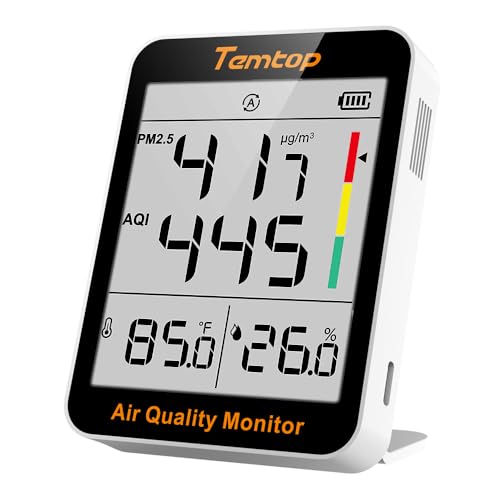
The Temtop S1 consolidates PM2.5, AQI, temperature, and humidity into a compact device designed for homes, offices, or classrooms. It emphasizes clear visual readouts to help users quickly gauge whether the environment is comfortable and healthy, with a simple 2-in-1 approach to air quality and environmental comfort detection.
16 in 1 Air Quality Monitor Indoor (YNAK) – 10h Battery
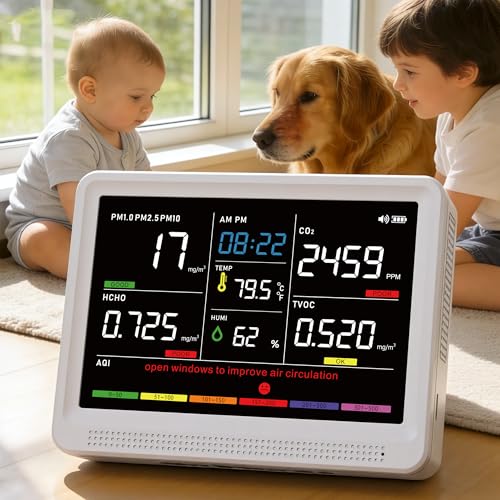
YNAK’s 16-in-1 monitor provides nine detected parameters plus seven AQI alert types, backed by a 10-hour battery life and a 5.5-inch display. External high-precision sensors target CO2, PM, HCHO, and VOCs, while real-time alerts help users respond to shifts in air quality. The design emphasizes accurate sampling and minimal procedural complexity.
LifeBasis Air Quality Monitor Indoor, 11-in-1

The LifeBasis model tracks 11 metrics, including AQI, CO2, PM1.0/2.5/10, HCHO, TVOC, and both temperature and humidity. It features a dual-alert system with visual and audible cues, making it suitable for homes with children or pets. The device uses a combination of NDIR and laser particle sensors to balance accuracy with broad measurement scope.
Buying Guide: Key Purchase Considerations
When selecting an indoor air quality monitor, consider the following factors to match your needs:
- Sensor Range and Metrics: Decide which pollutants are most relevant—CO2, PM2.5, VOCs, CO, HCHO, and AQI. Some devices offer 9–16 different measurements and multi-parameter readouts.
- Display and Alerts: Look for clear digital readouts and color-coded indicators. Some models include audible buzzers or smartphone/app alerts for real-time notifications.
- Calibration and Accuracy: Devices with smart or automatic calibration reduce maintenance. Check the stated accuracy (often ±5% for many consumer monitors) and sensor quality (NDIR, electrochemical, laser PM sensors).
- Power and Portability: Battery-powered models are convenient for flexible use, while plugged-in devices suit fixed spaces. Battery life ranges from several hours to ~12 hours or more in standby; some models recharge via USB-C.
- Display Size and Readability: A larger display or high-definition color screen improves readability, especially for quick checks at a glance.
- Smart Integration: Alexa or other smart-home integrations add convenience, enabling voice queries and automation when certain thresholds are met.
- Alarms and Data Logging: Consider models with real-time alarms and the ability to log historical data for trend analysis—useful for diagnosing seasonal changes or occupancy-driven fluctuations.
- Form Factor and Use Case: Portable monitors suit cars and travel, while wall- or desk-mounted devices fit offices and living rooms. Battery life, sensor array, and display are often trade-offs with portability.
- Maintenance: Check whether sensors require periodic replacement or calibration and what the manufacturer recommends for optimal performance.
- Price and Value: Compare features against price, prioritizing the most impactful metrics for your environment. Some multi-sensor devices deliver better long-term value by capturing more conditions.