For aspiring planetary observers, selecting the right eyepiece can dramatically improve surface detail, contrast, and field of view. This guide highlights five top eyepieces that excel at viewing planets, from flexible zoom models to high-contrast Plossl designs. Each option integrates with standard 1.25″ telescopes, supports comfortable viewing, and offers features that help reveal lunar curves, Jupiter bands, and Saturn’s rings. Read on to compare magnification range, eye relief, coatings, and field of view to find the best match for your telescope and sky conditions.
| Product | Brand | Magnification Range | Key Benefit |
|---|---|---|---|
| Celestron Zoom Eyepiece | Celestron | 8–24 mm | Single eyepiece, broad zoom range |
| Alstar 7–21 mm Zoom | A ALSTAR | 7–21 mm | Wide apparent field, comfortable eye relief |
| SVBONY 12 mm Plossl | SVBONY | 12 mm | Bright, multi-coated optics |
| SVBONY 25 mm Plossl | SVBONY | 25 mm | Wide field, filter thread ready |
| Astronomical 8–24 mm Zoom | Hyuduo | 8–24 mm | Green anti-reflective coating, solid build |
Celestron Zoom Eyepiece (8–24 mm)

The Celestron Zoom Eyepiece provides a seamless transition from low to high magnification, ideal for planetary drawing and quick focusing on interesting features. It covers a focal length range from 8 mm to 24 mm, reducing the need to carry multiple fixed focal length pieces. Designed for use with any telescope that accepts standard 1.25″ eyepieces, it also accepts 1.25″ filters for enhanced contrast or color saturation during planetary viewing.
Alstar 7–21 mm Zoom Eyepiece

The Alstar zoom eyepiece offers seamless focal length adjustment from 7 mm to 21 mm, making it versatile for planetary clusters and lunar details. It provides extended eye relief (16–33 mm) to accommodate eyeglass wearers, with a foldable rubber eyecup for comfortable viewing at all focal lengths. Its wide apparent field of view (30–47 degrees) helps frame planetary disks and nearby features more easily than narrower designs.
SVBONY SV131 12 mm Plossl

The SV131 Plossl eyepiece features a 12 mm focal length with a 48-degree wide field of view, optimized for planetary and lunar observation. Its multi-coated fully multi-layer coatings reduce glare and improve contrast, with matte lens edges to limit stray light. The result is sharper planetary images with clearer limb details and crisper star field edges.
SVBONY 25 mm Plossl Eyepiece

This 25 mm Plossl eyepiece is standard 1.25″ size with M28.5×0.6 mm filter threads, enabling easy integration with filters for planetary contrast enhancement. Its 40-degree field of view provides a wide context of the view while remaining bright enough for lunar and planetary observations. The fully multi-coated optics help deliver clear, bright images even when observing brighter planets and the Moon.
Astronomical 8–24 mm Zoom Eyepiece
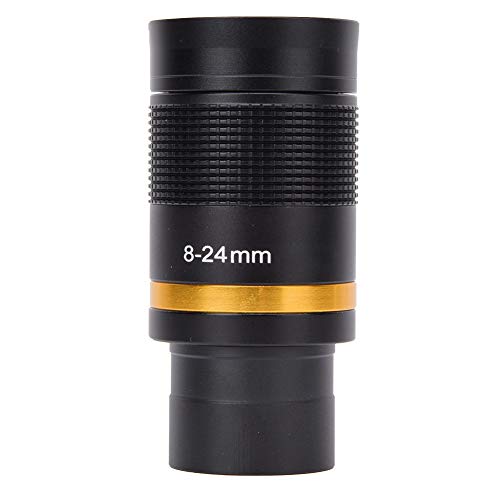
This 8–24 mm zoom eyepiece features an all-metal body and multi-layer anti-reflective green coating for improved optical performance. It is marketed for viewing the Moon, planets, and nebulae, with strong emphasis on reliable glare reduction and clear edge-to-edge performance. The robust build supports regular use at the telescope’s focal ranges used in planetary observing.
Buying Guide
Key purchase considerations when choosing eyepieces for planet viewing:
- Magnification range: Zoom eyepieces simplify the range you need; fixed focal lengths are fine, but a wide zoom can reduce the number of pieces you carry.
- Eye relief and comfort: For eyeglass wearers, longer eye relief and comfortable eyecups improve the viewing experience during longer sessions.
- Field of view: A wider apparent field of view helps locate planetary targets and frame moons and rings within the eyepiece.
- Coatings and contrast: Fully multi-coated optics and anti-reflective coatings boost brightness and contrast, especially under bright skies or when observing dimmer planetary features.
- Compatibility: Ensure the eyepiece fits standard 1.25″ telescope accessories and supports any filters you plan to use for planet viewing.
- Build and durability: Metal bodies tend to hold their alignment better over time and during transport than cheaper plastic designs.
- Edge performance: Some Plossl designs may show slight vignetting or edge softness; premium coatings and precise manufacturing reduce these effects.
- Weight and balance: Heavier eyepieces can affect telescope balance; consider mounting and supporting equipment accordingly.
When evaluating these options, consider your typical targets (Moon details, Saturn’s rings, Jupiter’s bands), your sky conditions, and whether you prefer the flexibility of a zoom or the perhaps slightly sharper edge performance of a fixed focal length eyepiece. A combination of a versatile zoom and a couple of well-muted fixed focal lengths often yields the broadest planetary viewing experience.