This guide presents beginner-friendly computerized telescopes that simplify locating stars, planets, and deep-sky objects. Each option combines GoTo or StarSense technology with ergonomic design, helping newcomers enjoy prime viewing sessions with minimal setup. The selections below are compact, beginner-focused, and come from trusted brands, making it easier to choose a model that fits your observing goals and budget.
| Product | Brand | Key Benefit |
|---|---|---|
| NexStar 130SLT Computerized Telescope | Celestron | Compact portability with a large 130mm aperture |
| StarSense Explorer LT 114AZ | Celestron | Smartphone-driven sky navigation |
| 114LCM Computerized Newtonian | Celestron | All-in-one package with tripod and eyepieces |
| NexStar 6SE | Celestron | Powerful 6-inch aperture with automated GoTo |
| NexStar 4SE | Celestron | Compact Maksutov-Cassegrain with GoTo |
Celestron NexStar 130SLT: Portable Computerized 130mm

The NexStar 130SLT combines a compact Newtonian reflector with a robust computerized hand control. It features a database of more than 4,000 celestial objects and SkyAlign technology for quick alignment. Compatible with 2 inch eyepieces, it balances portability with a respectable light-gathering aperture for observing the Moon, planets, and brighter deep-sky objects. The design suits family viewing trips and dark-sky weekend getaways where quick setup matters.
Celestron StarSense Explorer LT 114AZ App-Enabled Telescope
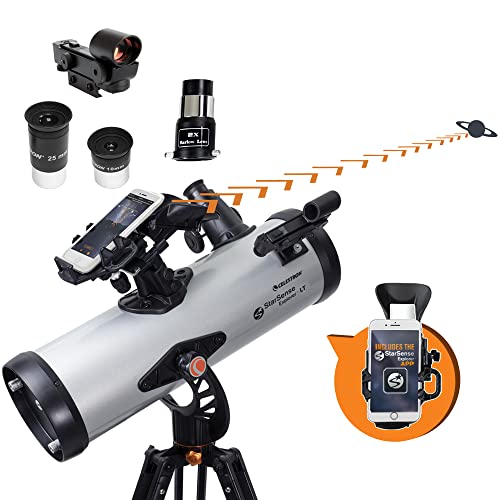
The StarSense Explorer LT 114AZ uses smartphone-powered sky mapping to guide beginners through the night sky. StarSense technology analyzes star patterns to pinpoint the scope’s position, while the StarSense app curates objects best viewed at your time and location. It’s a straightforward entry point for new stargazers who prefer a modern, app-driven experience without manual star-hopping.
Celestron 114LCM Computerized Newtonian

This 114LCM Newtonian telescope arrives with a fully computerized GoTo mount capable of locating about 4,000 celestial objects. The kit includes a full-height tripod and two eyepieces, plus a StarPointer red-dot finderscope for easier object acquisition. The Sky Tour feature simplifies observing by generating a ready-made list of current best targets based on your sky conditions.
NexStar 6SE Computerized Telescope

The NexStar 6SE combines a 6-inch Schmidt-Cassegrain optical tube with a fully automated GoTo mount. Its NexStar+ hand control provides access to a database of over 40,000 objects, enabling precise slews and tracking. The combination of power and portability makes it a favorite for ambitious beginners who want deep-sky capability without complexity in operation.
NexStar 4SE Computerized Maksututov-Cassegrain

The NexStar 4SE offers a compact Maksutov-Cassegrain design with a fully automated GoTo system and SkyAlign. Its smaller aperture is ideal for portability while still delivering crisp lunar, planetary, and brighter deep-sky views. The setup is straightforward, making it a strong option for beginners seeking ease of use with consistent performance.
ZWO Seestar S50 Smart Digital Telescope

The Seestar S50 is a compact all-in-one system that blends a telescope, motorized focuser, camera, and smart imaging capabilities with ASIAIR integration. It supports automatic find-and-track, live imaging progress, and voice updates. This model suits users who want an integrated, modern approach to both visual observing and astrophotography in one device.
Buying Guide: Key Purchase Considerations
- Observing goals: Decide whether you want casual viewing, planetary detail, or occasional deep-sky imaging. Higher apertures gather more light but increase size and cost.
- GoTo vs StarSense: GoTo mounts automate slewing to targets but can be pricier. StarSense-style smartphone integration offers a modern, app-driven experience without a heavy mount.
- Portability and setup: If you travel or attend star parties, a lighter, rugged telescope with a quick-align capability will be beneficial.
- Accessory ecosystem: Check included eyepieces, tripods, finder scopes, and whether future upgrades (additional eyepieces, cameras) are supported.
- Learning curve: Some models provide guided tours or built-in Sky Tour features that simplify initial observations and gradually introduce sky knowledge.
- Maintenance: Ensure ease of collimation (alignment) for reflectors and that the optical design matches your local observing conditions (light pollution, climate).
- Value vs complexity: For beginners, a balance between ease of use and future expandability offers long-term satisfaction and learning.
- Budget considerations: While advanced features boost capability, entry-level computerized scopes still deliver strong value for learning fundamentals.
Note: This article presents product summaries based on publicly listed features and user guidance. Actual performance will vary with observing conditions, location, and user familiarity with astronomical equipment.