CFexpress Type B cards have become essential tools for professional photographers and videographers who shoot high-resolution 4K, 6K, and 8K footage. This guide highlights top CFexpress cards that maximize speed, reliability, and storage capacity. We evaluate sustained write speeds, burst performance, heat handling, and durability to help you select the right card for your camera system and workflow. A quick product summary table is included, along with a buying guide to cover multiple perspectives on choosing the best CFexpress card for your setup.
| Product | Brand | Capacity | Key Speed |
|---|---|---|---|
| ProGrade Digital CFexpress 4.0 Type B (Gold) 240GB | ProGrade Digital | 240GB | Read up to 3100 MB/s; sustained write up to 700 MB/s |
| Sony CEA-G160T CFexpress Type A 160GB | Sony | 160GB | Read up to 800 MB/s; write up to 700 MB/s |
| Delkin Devices 512GB CFexpress Type B 4.0 | Delkin Devices | 512GB | Burst read up to 3650 MB/s; burst write up to 3240 MB/s |
| Nextorage 512GB CFexpress 4.0 Type B | Nextorage | 512GB | Read up to 3900 MB/s; write up to 3400 MB/s |
| Delkin 1TB CFexpress Type B 4.0 | Delkin Devices | 1TB | Burst read up to 3650 MB/s; burst write up to 3240 MB/s |
Note: All speeds are listed as maximums under optimal conditions. Actual performance depends on camera model, firmware, workflow, and card reader compatibility.
ProGrade Digital CFexpress 4.0 240GB Gold Series

The ProGrade Digital 240GB CFexpress 4.0 Type B Gold Series is engineered for sustained performance with write speeds reaching up to 700 MB/s. It targets high-demand applications such as continuous 4K, 6K, and 8K recording, helping minimize dropped frames during bursts. Compatibility with PCIe 1.4c and NVMe optimizes data transfer, and a high-speed read capability around 3100 MB/s accelerates offloads. The card is designed to balance speed with efficiency, and ProGrade’s software tools offer maintenance options to preserve performance over time. A suitable choice for professionals needing reliable, fast storage during fast-paced shoots.
Sony CEA-G160T 160GB CFexpress Type A
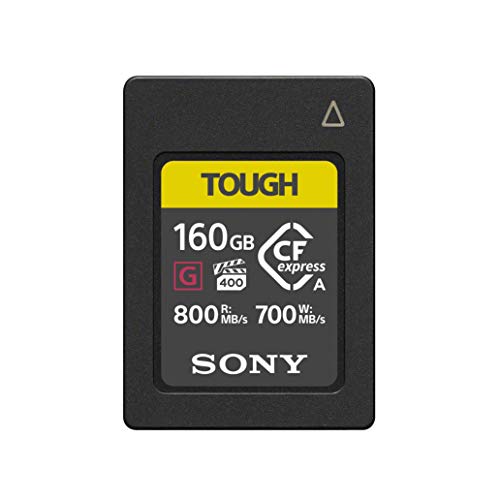
Sony’s CEA-G160T CFexpress Type A card offers up to 700 MB/s write and 800 MB/s read speeds, paired with a heat-dissipating heat sink design. The packaging emphasizes durability with improved resistance to impacts, ideal for long recording sessions in demanding environments. While smaller in capacity, Type A cards are often favored for certain cameras that support the A2 standard and require lower power consumption, which can help extend battery life during extended shoots. Suitable for professionals using compatible Sony cameras or devices that benefit from efficient thermal management and solid transfer speeds.
Delkin Devices 512GB CFexpress 4.0

Delkin’s 512GB POWER 4.0 CFexpress Type B card delivers burst read speeds up to 3650 MB/s and burst write speeds up to 3240 MB/s, with a sustained write around 820 MB/s for substantial workloads. It is designed for high-end cinema and still photography workflows, enabling quick offloads and fast post-production. The card includes a rugged, shockproof and waterproof build, and typically comes with a protective case for travel and field use. This model suits professionals handling large RAW files and 4K/6K/8K footage in fast-paced shooting environments.
Nextorage 512GB CFexpress 4.0 Type B

Nextorage, founded by former Sony engineers, specializes in reliable CFexpress storage. The 512GB model delivers read speeds up to 3900 MB/s and write speeds up to 3400 MB/s, making it a strong option for high-frame-rate recording and long takes. The Japanese design ethos emphasizes reliability and compatibility across a range of mirrorless and DSLR cameras. For users prioritizing maximum sustained throughput with a compact capacity, Nextorage presents a compelling balance of speed and dependability.
Delkin Devices 1TB CFexpress 4.0

Delkin’s 1TB CFexpress 4.0 Type B card targets professionals requiring expansive storage for lengthy shoots. It offers burst reads up to 3650 MB/s and burst writes up to 3240 MB/s, with a sustained write of 1570 MB/s on larger cards. The durability features are consistent with Delkin’s rugged design, including shockproof and waterproof construction. This capacity is particularly useful for extended 4K/6K/8K sessions, helping maintain smooth playback and efficient post-production workflows without frequent card swaps.
Buying Guide: Key Considerations For CFexpress Cards
- Speed class and sustained writes: For high-frame-rate recording, prioritize cards with high sustained write speeds (ideally 700 MB/s to 1500 MB/s) and strong read speeds to speed up offloads.
- Capacity needs: Choose based on typical project length. Professionals shooting long events or large RAW files may prefer 512GB or 1TB, while episodic or travel shoots might fit 240GB–512GB models.
- Camera compatibility: Verify that your camera model supports CFexpress 4.0 Type B and is compatible with the card’s firmware requirements and reader options.
- Durability and heat management: Heat dissipation features, rugged design, and water/shock resistance minimize risk in field environments and long takes.
- Warranty and software: Look for cards with reliable warranties and optional software like firmware updates or maintenance tools that help preserve performance over years of use.
- Readout efficiency: High read speeds reduce wait times when transferring footage to editors, which can improve overall production workflow.
- Future-proofing: If you plan to upgrade cameras, choosing higher-capacity and faster cards may extend the utility of your investment.
When selecting a CFexpress card, consider your camera’s supported formats, your typical shooting style, and your post-production workflow. While one card may excel in sustained write speed, another might offer better heat management or greater capacity, depending on your priorities. By balancing speed, capacity, and durability, you can align your purchase with your creative and professional needs.