When exploring the night sky, choosing the right CCD camera can shape your planetary, lunar, and deep-sky captures. The following selections emphasize high resolution, good sensitivity, and beginner-friendly setup for American enthusiasts exploring Solar System and beyond. Each option balances ease of use with imaging quality, helping you decide which camera fits your telescope and observing goals.
| Product | Brand | Key Benefit |
|---|---|---|
| Celestron NexImage 20 Solar System Camera | Celestron | High-resolution Solar System imaging with 20 MP sensor |
| SVBONY SV105 Telescope Camera | SVBONY | Beginner-friendly, USB2.0, easy video capture |
| Celestron NexImage 5 Solar System Imager | Celestron | Simple plug-and-play for lunar & planetary shots |
| SVBONY SV305C Astrophotography Camera | SVBONY | Low-light capable color imaging for EAA and planetary |
| SVBONY SV705C Telescope Camera | SVBONY | Higher resolution planetary imaging with strong performance |
Note: All products listed are compatible with standard 1.0″ to 1.25″ telescope setups and offer varying levels of sensitivity, readout speed, and ease of use. The selection prioritizes cameras that are widely supported by imaging software and provide straightforward integration for beginners and intermediate observers alike.
Celestron NexImage 20 Solar System Camera

The NexImage 20 uses a 20 MP AR2020 back-illuminated CMOS sensor to deliver high-resolution lunar, planetary, and solar details. It is designed for plug-and-play operation with many telescopes and computers, enabling rapid start-to-imaging sessions. The sensor’s small pixel size and high resolution support crisp surface features while maintaining manageable noise levels for Solar System targets when paired with appropriate exposure settings and stacking workflows. It is optimized for Moon, planets, and Sun imaging with a filter for solar work when used safely.
SVBONY SV105 Telescope Camera
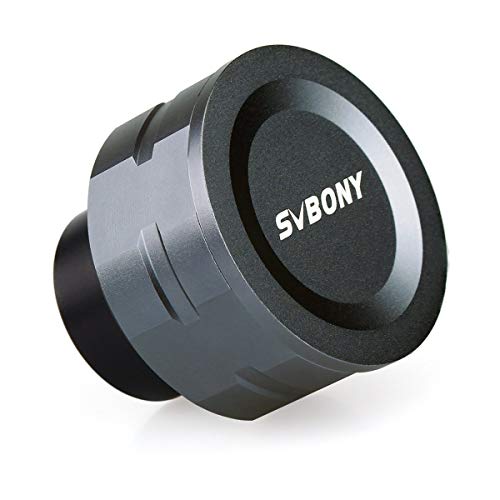
The SV105 is an entry-level, 1.25″ USB2.0 color astrophotography camera designed for lunar and planetary imaging. It supports quick video capture and real-time viewing on a laptop or PC, with no driver installation required on Windows for basic use. It is compatible with Sharpcap Capture for live stacking and processing, and with AstroDMx Capture on Linux. This camera offers a straightforward path for beginners to start capturing planetary detail and bright Moon features.
Celestron NexImage 5 Solar System Imager

The NexImage 5 provides beginner-friendly imaging with a 5 MP CMOS sensor for high-resolution color lunar and planetary shots. Its plug-and-play USB 2.0 interface connects to Windows computers without requiring external power. This camera is designed for quick success with Pluto- or planet-focused sessions, offering an approachable route into planetary imaging and basic stackable processing of captured frames.
SVBONY SV305C Astrophotography Camera

The SV305C offers a color entry-level solution with the IMX662 sensor and a 1/2.8″ back-illuminated design. It emphasizes low readout noise and improved NIR performance, supporting planetary and lunar imaging as well as quick, guided Target of Opportunity sessions for EAA. Its sensitivity and compact form make it a solid stepping stone into more advanced imaging without requiring a heavy upgrade path.
Alstar 1.25 Inch Flip Mirror

The Alstar flip mirror enables precise alignment of the target in both the eyepiece and the camera’s field of view. Its 45-degree tilting mirror facilitates accurate focusing and parfocal setup, helping to keep the object centered in the eyepiece and in the camera’s chip. This accessory improves focus accuracy and alignment during CCD or CMOS imaging sessions, especially for longer planetary and lunar captures.
SVBONY UV/IR Cut Filter for CCD Imaging

This 1.25″ UV/IR cut filter blocks unwanted ultraviolet and infrared light, improving image contrast and color fidelity for CCD and CMOS sensors. It also serves as a protective lens element, reducing chromatic aberration and maintaining natural colors. The filter is well-suited for planetary photography and bright deep-sky targets where spectrum control matters.
4K Wireless Telescope Camera (SV-EP03)

This universal eyepiece camera supports 4K video and up to 64 MP images with an 8 MP sensor. A rotatable 2.8-inch IPS display and WiFi streaming enable remote viewing within a typical 32-foot range. It fits a wide range of eyepiece diameters and is compatible with various optical setups, offering flexibility for outreach, education, and night-sky observation.
SVBONY SV705C Telescope Camera

The SV705C uses the IMX585 sensor for higher full-well capacity and a strong signal-to-noise ratio, making it suitable for detailed planetary imaging and entry-level deep-sky attempts. Its compact 1/1.2″ sensor size, 3856×2180 resolution, and 11.2 mm by 6.3 mm image area support rich feature capture of moons, rings, and planets. It’s positioned for enthusiasts progressing beyond beginner setups.
Buying Guide
- Sensor and resolution: Higher MP counts provide more detail but require careful gain/exposure management. Balance resolution with readout noise and frame rates for your targets.
- Connectivity and software: USB 2.0/USB-C compatibility, driver availability, and software support (e.g., SharpCap, AstroDMx, or native capture apps) affect ease of use and stacking workflow.
- Target focus: For planetary and lunar work, ensure the camera supports high frame rates and stabilization to enable lucky imaging and stacking of the best frames.
- Sensor type and sensitivity: Back-illuminated sensors and low readout noise help in dim targets and faint features; consider IR cut filters for sharper color in planets and Moon.
- Accessories: Flip mirrors, UV/IR cut filters, and eyepiece adapters can improve alignment, focus, and image quality, especially for beginners integrating a new camera with an existing telescope.
- Compatibility: Check compatibility with your telescope’s diameter (1.25″ vs. 2″) and ensure your mount can sustain the weight and exposure durations required for your chosen targets.