For compact PC builds and budget-conscious upgrades, low-profile graphics cards offer a blend of space efficiency and reasonable performance. The following five cards prioritize form factor and value while delivering capable visuals for everyday gaming, media, and productivity. Each option fits standard small-form-factor cases and supports modern display setups suitable for home theaters, offices, or refurbished systems.
| Product | Key Feature | Memory | Approx. Size |
|---|---|---|---|
| MSI GT 1030 LP OC | Entry‑level gaming with low power | 4GB DDR4 | Low profile |
| GIGABYTE GV-N1030D4-2GL | Compact GT 1030 with 2GB DDR4 | 2GB DDR4 | Low profile |
| SOYO Geforce GT 740 LP | Low-profile 740 with 4GB DDR3 | 4GB DDR3 | Low profile |
| Sparkle Arc A310 ECO | Arc A310 with 4GB GDDR6, ECO design | 4GB GDDR6 | Low profile |
| SAPLOS GT 730 LP | Kepler-based, dual/quad display options | 4GB DDR3 | Low profile |
MSI Gaming GeForce GT 1030 4GB LP OC
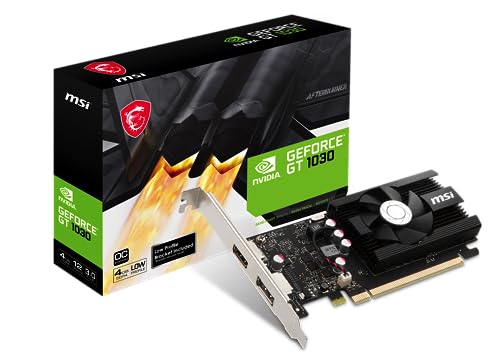
The MSI GT 1030 LP OC uses the NVIDIA GeForce GT 1030 chipset with 4GB of DDR4 memory and a 64-bit interface. With a boost clock around 1430 MHz, it targets entry-level gaming and media tasks while maintaining a compact form factor. Its low-profile design fits small cases and SFF builds, and Power/HDCP compliance supports modern displays. This card is suitable for casual gaming, streaming, and light content creation on budget systems.
GIGABYTE GV-N1030D4-2GL GeForce GT 1030 LP

Powered by the GeForce GT 1030, this GIGABYTE card comes with 2GB of DDR4 memory and a 64-bit bus, all packed into a low-profile 150 mm form factor. The compact size makes it ideal for slim desktops and home theaters, while the 2GB memory keeps energy use modest. It provides reliable performance for everyday tasks and light gaming, with straightforward driver support and easy installation in compact cases.
Glorto GeForce GT 730 LP with Dual HDMI

Glorto’s GT 730 LP uses a 28nm GK208 core with 902MHz clock. It ships with 4GB DDR3 and dual HDMI plus VGA/DP support, enabling multi-monitor setups. The low-profile design suits compact builds or HTPCs, and Windows 11 compatibility broadens software applicability. This card emphasizes stable everyday performance with flexible display outputs for multi-screen configurations.
SOYO Geforce GT 740 LP Low Profile

The SOYO GT 740 LP offers 4GB DDR3 memory across a 128-bit interface, delivering higher bandwidth for its class. It includes HDMI 2.0, VGA, and DVI, supporting a variety of monitors and simple multi-monitor setups. Its 28nm process and single fan design emphasize a balance of performance and efficiency in compact cases, making it a practical upgrade for budget builds.
Sparkle Arc A310 ECO 4GB

Sparkle’s Arc A310 ECO is a low-profile card built around the Intel Arc A310 chipset, featuring 4GB of GDDR6 memory and a 50W TBP. It includes HDMI and dual mini DisplayPort outputs, supporting multiple displays. The ECO design focuses on low power consumption in compact builds, suitable for home offices and multimedia centers that require modern connectivity in a budget-friendly package.
Buying Guide
Key purchase considerations for budget low-profile graphics cards include power and size constraints, memory capacity, and display needs. In compact systems, a low-profile and single- or dual-slot design helps with case compatibility and airflow. Memory size (2GB vs 4GB) affects contemporary gaming and multitasking performance, with DDR4 generally faster than DDR3 in this class. Display options such as HDMI, DisplayPort, and VGA should align with your monitor setup and any adapters you plan to use.
Performance expectations vary by GPU era. GT 1030‑class cards are suited for light gaming and multimedia tasks, basic photo/video editing, and office workflows. GT 730 and GT 740 options typically serve entry-level gaming and multi-display scenarios at modest resolutions. The Sparkle Arc A310 ECO and similar Arc or newer low-profile GPUs offer improved efficiency and newer connectivity but may have driver and software considerations on older systems. Always verify driver support for your operating system and ensure your power supply and PCIe slot requirements align with the card.
Consider future-proofing within budget constraints. If you anticipate higher-resolution gaming or demanding workloads, balance memory capacity and bandwidth with the card’s architectural efficiency. For multi-monitor setups, prioritize GPUs with multiple outputs and reliable driver support. Finally, confirm warranty terms and seller reputation on Amazon to minimize post-purchase issues and ensure compatibility with your PC case’s internal layout.