Discover approachable telescopes that make stargazing fun and educational for kids and beginners. This guide highlights five beginner-friendly models with easy setup, kid-friendly features, and opportunities to capture celestial moments. Each pick includes practical optics, portability, and beginner-friendly accessories to help new stargazers explore the night sky with confidence.
| Product | Aperture | Focal Length | Key Features |
|---|---|---|---|
| Gskyer 70mm Refractor | 70mm | 400mm | Coated optics, two eyepieces, Barlow lens, wireless remote, phone adapter |
| Blue Marble NASA Lunar Telescope | 90x magnification (optical) | Tabletop design | Moon details, finder scope, simple setup, tabletop tripod |
| ToyerBee 70mm Refractor | 70mm | 300mm | Two eyepieces, Barlow lens, phone adapter, wireless remote |
| EACONN 80mm Refractor | 80mm | 600mm | Rough adjustment gimbal, 2 eyepieces, finder scope, mobile adapter |
| Luzsco Kids Telescope 50mm | 50mm | 100x (via eyepieces) | Tripod, 2 eyepieces, Barlow lens, durable build |
Gskyer 70mm Refractor for Kids

Gskyer’s 70mm refractor provides a compact, kid-friendly entry into astronomy. With a 400mm focal length (f/5.7) and fully coated glass optics, the telescope delivers bright, sharp views of the Moon and planets. The kit includes two replaceable eyepieces and a 3x Barlow lens to extend magnification, helping young stargazers explore more distant objects. A 5×24 finder scope with crosshair makes object locating easier, while a wireless remote and phone adapter enable easy image capture and sharing of celestial moments.
NASA Lunar Telescope for Kids
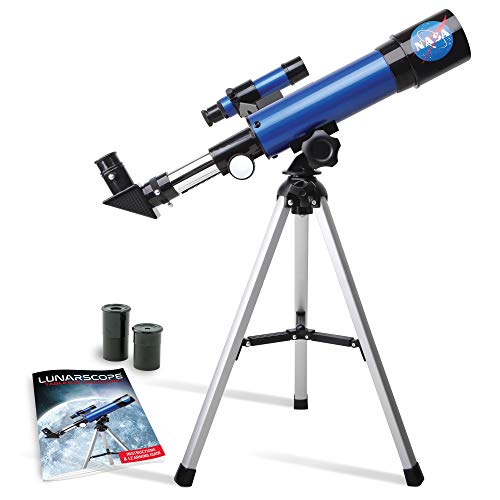
The NASA Lunar Telescope is designed to spark curiosity about the Moon and space. With a tabletop tripod and a simple optical path, children can easily align, locate, and zoom in on lunar details. The package emphasizes high-quality optical glass and a finder scope to help beginners focus on objectives. This compact setup is ideal for indoor demonstrations or small outdoor viewing sessions, offering an accessible gateway to astronomy without requiring extensive assembly.
ToyerBee 70mm Refractor for Kids & Beginners

This ToyerBee model targets beginners with a practical 70mm aperture and a 300mm focal length. It ships with two eyepieces (H20mm and H6mm), a 3x Barlow lens, and a weighted focus system that supports magnifications from 15x to 150x. The included phone adapter and wireless remote simplify capturing images, while the sturdy tripod enhances stability for classroom-style demonstrations or backyard stargazing sessions.
EACONN 80mm Refractor for All Ages

EACONN offers a larger 80mm aperture with a fully coated optics glass lens, designed to capture more light for brighter, clearer views. A rough adjustment and positioning gimbal helps new users align the telescope with minimal effort, while two eyepieces (K20mm and K9mm) and a 5×24 finder scope simplify locating objects. The included mobile phone adapter supports taking photos or videos from your viewing session, making it a solid family-friendly option.
Luzsco Kids Telescope 50mm

The Luzsco 50mm beginner telescope is compact and child-friendly, featuring a complete starter kit for young stargazers. It includes a sturdy tripod, two eyepieces, a Barlow lens, and a finder scope to help kids identify craters on the Moon and nearby planets. Its simplified design and durable construction make it suitable for backyard astronomy, science fairs, or classroom demonstrations.
Buying Guide: Key Considerations for Young Stargazers
- Aperture and light gathering: Larger apertures (50–80mm) collect more light, producing brighter, clearer views of the Moon, planets, and brighter deep-sky objects. For beginners, a 70–80mm aperture balances performance with portability.
- Focal length and magnification: A modest focal length (around 300–600mm) supports versatile magnification when paired with multiple eyepieces and a Barlow lens. Avoid models that overemphasize high magnification, which often yields dim or blurry images for beginners.
- Optics quality: Fully coated optics improve light transmission and reduce glare. Look for refractors with quality glass lenses and anti-reflective coatings for crisp views.
- Ease of use: Simpler assemblies, intuitive mounts, and included accessories (eyepieces, finder scope, tripod) help maintain engagement. Child-friendly handling and weight are important for younger users.
- Stability and portability: A stable tripod or mount minimizes shaking, especially for photography attempts with a phone adapter. Lightweight designs support family outings and travel.
- Imaging capabilities: If capturing moon snapshots or planets is a goal, ensure the telescope includes a phone adapter or wireless remote to facilitate easy image capture.
- Educational value: Look for kits that come with moon maps, star charts, or guided experiments to extend learning beyond viewing sessions.
- Expandability: Some models offer upgradeable eyepieces or optional accessories; this can extend use as a child’s interest grows.
Overall, the best beginner telescope for kids combines safe, easy setup with clear views and engaging features. Wireless remotes, phone adapters, and accessible finders enhance learning and fun, while larger apertures and stable mounts improve long-term usability.