Discover top bass-friendly volume pedals that offer smooth control, reliable construction, and versatile performance options. This guide highlights five popular pedals that work well with passive and active signals, including express and dual-function units for on-stage and studio use. Each entry covers core features, build quality, and why it matters for bass players seeking precise tone shaping.
| Product | Brand | Key Benefit |
|---|---|---|
| Ernie Ball VP JR 250K Volume Pedal | Ernie Ball | Compact JR size with mono volume control and taper switch |
| Ernie Ball 40th Anniversary Volume Pedal | Ernie Ball | Classic reliability with improved Kevlar cord for precise control |
| SONICAKE Passive Volume & Expression EXP Pedal | SONICAKE | 2-in-1 passive volume and expression in one compact unit |
| Btuty Volume Expression Pedal EXP & Passive Volume | Btuty | Durable metal chassis; silent operation and versatile 2-in-1 design |
| Donner Volume Pedal, Viper 2 in 1 | Donner | Automatic switching between volume and expression modes |
Ernie Ball VP JR 250K Volume Pedal

The VP JR 250K is a compact, passive signal volume pedal designed for pedalboard-friendly setups. Its smaller footprint helps conserve real estate while maintaining sturdy construction. The mono volume control provides a straightforward sweep, and the taper switch offers two swell rates for dialing in a bass’s dynamic response. Ideal for players who want predictable response without extra expense on unnecessary features.
Ernie Ball 40th Anniversary Volume Pedal

This limited-edition 40th Anniversary pedal offers a compact chassis and a refined control experience. The improved Kevlar cord contributes to reliable, consistent volume changes, which is beneficial for bass players seeking longevity and precise response across the pedal travel. It accommodates both active and passive signals, making it versatile for various setups.
SONICAKE Passive Volume & Expression EXP Pedal
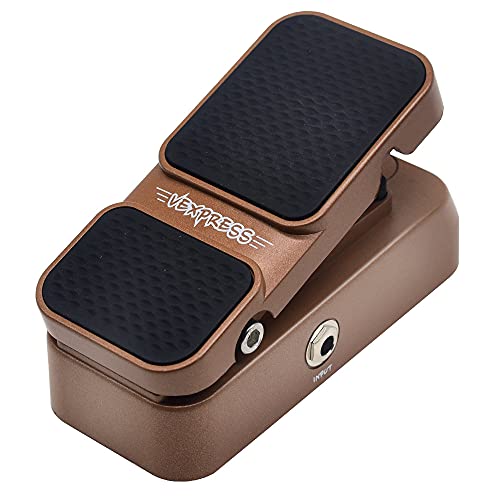
SONICAKE’s EXP Pedal combines passive volume control and expression capability in a single compact unit. It detects whether to operate as a volume or an expression pedal automatically, reducing setup complexity. Suitable for bass players when paired with a TRS cable for seamless tone shaping, this pedal supports diverse instruments beyond guitar, including keyboards and synths.
Btuty Volume Expression Pedal EXP & Passive Volume

Btuty offers a versatile 2-in-1 design with a durable metal chassis and silent operation. The dual control options cover both volume and expression, enabling smooth, lag-free tone shaping during live performance. A good choice for bassists who want a compact, robust pedal capable of handling energetic stage use while maintaining precision in parameter changes.
Donner Volume Pedal, Viper 2 in 1

Donner’s Viper pedal combines passive volume and expression functionality with automatic switching, simplifying setups for players who switch between volume and expressive modulation without changing pedals. The 2-in-1 design suits bassists who want a streamlined board and quick tonal adjustments during performances, rehearsals, or recording sessions.
Buying Guide
Key purchase considerations for bass players include signal compatibility, build quality, and control feel. A passive pedal is ideal if you want a simple, unpowered option, but ensure the unit works well with your instrument’s output impedance. For active basses or longer signal chains, consider pedals that handle impedance well and preserve tone without excessive treble cut or bass loss.
- Impedance and compatibility: Verify your bass’s output and the pedal’s input impedance. Some pedals perform better with passive signals, while others are tuned for active setups.
- Control type and taper: Decide whether you prefer a linear or logarithmic sweep, and whether you need a two-sweep taper switch for different swell rates.
- 2-in-1 functionality: If you want both volume and expression in one unit, evaluate how seamless the switch is between modes and whether the device preserves dynamic nuance.
- Durability and footprint: For on-stage use, choose a pedal with robust chassis, secure foot tread, and a footprint that fits your pedalboard layout.
- Noise and signal integrity: Look for silent operation and well-shielded enclosures to reduce hum or unwanted noise during performances or recordings.
- Power needs: Passive pedals require no power, while active or hybrid units may need a battery or power supply. Plan according to your rig’s power strategy.
In evaluating these options, bass players should balance size, control precision, and the ability to integrate with existing effects chains. Pedals offering reliable passive performance, smooth sweeps, and stable construction tend to deliver the most consistent tone across rehearsal and gig environments.