Discover beginner-friendly telescopes that simplify stargazing with smart features like smartphone docking, automated target suggestions, and GoTo mounts. This guide covers five entry-level, auto-enabled models ideal for learning the night sky without a steep learning curve. Each option combines portability, ease of setup, and solid optics to help new observers spot planets, nebulae, galaxies, and star clusters from both urban and dark-sky locations.
Summary table of chosen products:
| Product | Key Feature | Type | Best For |
|---|---|---|---|
| Celestron StarSense Explorer LT 114AZ | Smartphone-powered sky tour with StarSense | 114mm Newtonian | Beginner to intermediate users |
| ZWO Seestar S50 | All-in-one smart telescope with auto find/track | Portable integrated system | Compact, tech-forward beginners |
| Celestron StarSense Explorer LT 80AZ | Smartphone docking and StarSense tech | 80mm Refractor | Travel-friendly setup |
| Celestron StarSense Explorer DX 130AZ | 130mm Newtonian with StarSense | Newtonian | More light-gathering for deep-sky |
| Celestron NexStar 6SE | GoTo computerized mount with SkyAlign | 6″ Schmidt-Cassegrain | Serious beginners to intermediate |
Celestron StarSense Explorer LT 114AZ App-Enabled Telescope
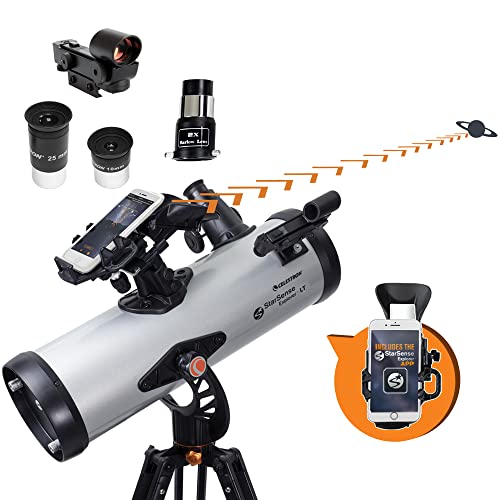
The LT 114AZ blends a 114mm Newtonian optical tube with StarSense technology and a convenient smartphone dock. The StarSense Explorer app analyzes star patterns to determine the telescope’s position, guiding users to celestial targets with on-screen arrows. An auto-generated list of tonight’s best objects helps beginners locate planets, nebulae, galaxies, and star clusters even from light-polluted areas. This model emphasizes quick setup and user-friendly navigation, making it a strong choice for first-time stargazers who want immediate results without manual star-hopping.
ZWO Seestar S50 Smart Digital Telescope

The Seestar S50 is a compact, all-in-one smart telescope that integrates a telescope, motorized focuser, astronomical camera, and control software. It emphasizes lightweight design (about 2.5 kg) while delivering clean, low-noise images, aided by professional-grade optics to minimize chromatic aberration. Its full-automatic find & track features, accessible via a smartphone, make it ideal for users who want automated target selection, live imaging progress feedback, and GoTo-style navigation without separate mounts. This option suits beginners who value a modern, tech-driven experience.
Celestron StarSense Explorer 114AZ

This tabletop 114AZ model brings smartphone-powered sky discovery to a compact form. The StarSense technology analyzes star patterns to pinpoint the telescope’s position, followed by tonight’s best targets displayed within the app. The combination of a stable tabletop mount and a user-friendly sequence helps new observers quickly locate celestial objects with confidence, while maintaining a small footprint suitable for indoor use or travel.
Gskyer Telescope, 70mm Refractor for Beginners

The Gskyer 70mm refractor emphasizes portability and value for newcomers. It includes multiple eyepieces and a 3x Barlow lens to provide varying magnifications, a 5×24 finder scope for object locating, and a wireless remote to capture images. While not strictly an automated GoTo, its simple design and accessory kit make it a versatile starter option for families or students exploring the night sky under varying viewing conditions.
Celestron StarSense Explorer LT 80AZ

The LT 80AZ pairs an 80mm refractor with smartphone docking and StarSense technology for quick celestial alignment and object discovery. The app generates a curated list of targets based on your time and location, making it straightforward to observe planets, nebulae, and clusters from urban environments. With its compact size, this model is well suited for travel or quick backyard sessions where setup speed matters most.
Celestron StarSense Explorer DX 130AZ
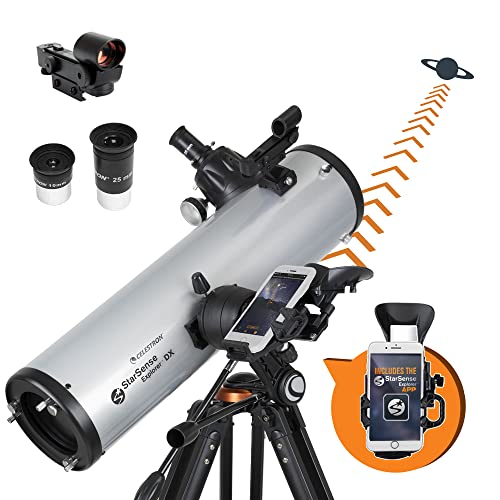
The DX 130AZ expands to a 130mm Newtonian, combining StarSense technology with smartphone-based alignment and guided targeting. The larger aperture improves light-gathering for fainter deep-sky objects, while the automatic targeting features remove most of the guesswork. This model is a strong option for beginners who want a step up from 80–114mm scopes without complex manual alignment procedures.
Celestron NexStar 6SE Computerized Telescope

The NexStar 6SE combines a 6-inch Schmidt-Cassegrain optical tube with a fully automated GoTo mount and SkyAlign technology. It offers a vast database of more than 40,000 objects and precise, automated slews to targets. While more advanced than entry-level models, it remains accessible to motivated beginners who want robust performance, better deep-sky visibility, and a system that can grow with their skills. This is a long-term investment in learning the night sky.
Buying Guide: Key Purchase Considerations
- Optical diameter (aperture): Larger apertures gather more light, improving visibility of planets and deep-sky objects. For beginners, 80–130mm is a practical range, balancing portability and performance.
- Mount type: GoTo and StarSense-enabled mounts simplify finding objects. Tabletop or alt-azimuth mounts are portable; equatorial mounts are better for tracking and long-exposure imaging.
- Automation features: Smartphone docking, star recognition, and auto-target lists save time and reduce frustration for newcomers.
- Portability and storage: Consider weight, handling, and whether you’ll travel with the telescope to dark-sky sites.
- Imaging capabilities: If you want to capture pictures, check for a compatible camera adaptor, sensor sensitivity, and image-processing options.
- Accessories and upgrade path: eyepieces, Barlow lenses, finders, and mounts often determine how quickly you outgrow a telescope.
- Skill progression: Entry-level models with upgrade paths (e.g., from StarSense to GoTo or larger apertures) let beginners scale their observing experience over time.
- Warranty and support: Reputable brands with robust customer service help new users solve alignment and setup issues.
This guide emphasizes objective, feature-focused comparisons tailored for American readers seeking easy-to-use, auto-enabled telescopes. Each option prioritizes straightforward assembly, quick celestial targets, and reliable optics suitable for beginners while offering room to grow with advancing interest in astronomy.