Choosing the right amplifier for 4-ohm car speakers involves evaluating power delivery, efficiency, and build quality. The following selections are designed to maximize clarity, dynamics, and reliability across typical 4-ohm speaker setups. This guide highlights five noteworthy models, pairing objective specs with practical installation notes to help you compare options quickly.
| Product | Brand | Impedance | Power (RMS) | Type |
|---|---|---|---|---|
| DS18 SXE-1200.4/RD | DS18 | 4 Ω | 60×4 @ 4 Ω | Class A/B |
| RECOIL DI1200-4 | RECOIL | 2-4 Ω | 210-300 W x 4 @ 4 Ω | Class D |
| RECOIL DI550.4 | RECOIL | 2-4 Ω | 80-130 W x 4 @ 4 Ω | Class D |
| PRV Audio MDX1200.4 | PRV AUDIO | 2 Ω | 300 W x 4 @ 2 Ω | Digital Class D |
| DS18 SXE-2000.4D/RD | DS18 | 4 Ω | 150 W x 4 / 320 W x 2 bridged @ 4 Ω | Class D |
DS18 SXE-1200.4/RD Car Amplifier

The SXE-1200.4/RD is a full-range Class A/B four-channel amplifier built to drive 4-ohm speakers with strong, clean output. Its fully variable crossover and adjustable gain input sensitivity provide precise tuning for a tailored listening experience in a car audio system. The compact design helps with installation in custom builds while delivering robust power and reliable performance for daily use.
RECOIL DI1200-4 Full-Range Class-D Amp

The DI1200-4 uses a Class-D design to deliver high efficiency and substantial power, with up to 210-300 W per channel at 4 Ω depending on configuration. It offers a high-speed MOSFET power supply and extensive 4-way protection circuitry. Tunable via gain, LPF, HPF, crossover, and bass EQ, this amp supports varied installations while maintaining performance across demanding audio tracks.
RECOIL DI550.4 4-Channel Amp

The DI550.4 is a compact Class-D four-channel amplifier designed for 2-4 Ω speaker setups. With 130 W per channel at 4 Ω, it balances power with efficiency. Its adjustable controls—gain, LPF, HPF, crossover, and bass EQ—allow flexible tuning for varied vehicles, from daily drivers to custom builds, while maintaining reliable operation over time.
PRV Audio MDX1200.4 4x300W @ 2Ω
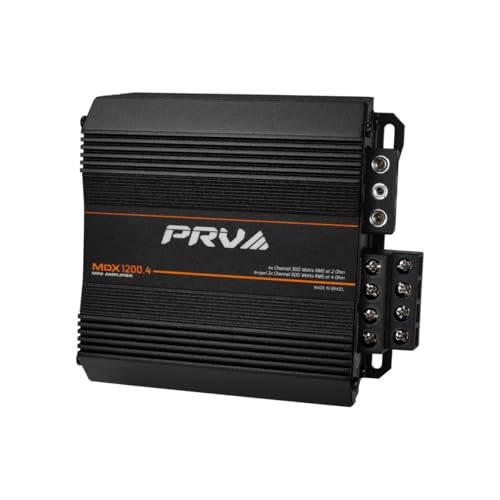
The MDX1200.4 is a 2-ohm-stable four-channel amp delivering true RMS power, with digital Class D design and bridgeable options to increase per-channel output. Wiring multiple speakers with a bridged configuration becomes practical for larger systems, and the amplifier’s efficiency helps reduce heat and power draw during extended usage.
DS18 SXE-2000.4D/RD 4-Channel Amp

The SXE-2000.4D is a Class D four-channel amplifier with substantial bridging capability. It delivers 320 W x 2 channels bridged at 4 Ω, and 160 W x 4 channels at 2 Ω, with a 100 W x 4 channel rating at 4 Ω. This model emphasizes high efficiency and strong power delivery, ideal for premium 4-ohm speaker configurations in custom installations.
Buying Guide: Key Considerations For 4 Ohm Speaker Setups
Power compatibility: Ensure the amp’s RMS power per channel matches or exceeds your speaker’s rating at the target impedance. Overdriving 4-ohm speakers can cause distortion or damage, especially at high volume levels.
Impedance flexibility: Look for models that support 4 Ω, and if you plan to upgrade, consider amps that handle 2 Ω loads for more headroom. Bridging capabilities can further increase per-channel output when needed.
Class design: Class D provides higher efficiency and cooler operation for mobile setups, while Class A/B may offer some sonic advantages in certain systems. Balance efficiency with desired sound quality and thermal considerations.
Adjustability: Variable crossovers (LPF/HPF), gain control, and bass EQ help tailor the amp to your vehicle’s acoustics and speaker placement. A well-tuned system delivers clearer mids and controlled bass without fatigue.
Protection and reliability: Four-way protection (short-circuit, thermal, overcurrent, and speaker protection) keeps both amp and speakers safe during long listening sessions and in varying climates.
Installation practicality: Consider the amp’s size, mounting options, and wiring requirements. Compact designs and clear labelings simplify integration into factory or custom builds.
Budget and future-proofing: While higher-widelity amps may cost more, prioritizing a model with scalable features (bridging, 2 Ω capability, robust cooling) helps future upgrades without a full system overhaul.