Wireless in-ear monitors (IEMs) have become essential for musicians, sound engineers, and performers who seek clear, reliable audio without the clutter of cables. Choosing the right wireless IEM system can dramatically improve stage experience, studio monitoring, and live performances. Below is a summary table featuring some of the latest high-quality wireless in-ear monitors available on Amazon, followed by detailed product reviews to help you make an informed decision.
| Product | Brand | Frequency | Latency | Battery Life | Max Range |
|---|---|---|---|---|---|
| Xvive U45 Wireless In Ear Monitor System | Xvive | 5.8 GHz | Not Specified | Not Specified | 100 ft |
| Xvive U4 Wireless In-Ear Monitor System | Xvive | 2.4 GHz | <5 ms | 5 hours | Not Specified |
| LEKATO Wireless In Ear Monitor System MS-02 | LEKATO | 2.4 GHz | <4.5 ms | 6-8 hours | Not Specified |
| Phenyx Pro Quad-Channel Wireless IEM System | Phenyx Pro | UHF 4×25 Frequencies | Not Specified | Not Specified | 140-164 ft |
| LEKATO Wireless In Ear Monitor System MS-1 | LEKATO | 2.4 GHz | Not Specified | Not Specified | Not Specified |
Xvive U45 Wireless In Ear Monitor System 5.8GHz

The Xvive U45 offers a reliable 5.8 GHz true diversity wireless connection that maintains solid RF signal over a 100 ft (30.5 m) distance. It is designed to avoid interference with other wireless devices, making it ideal for onstage performances or studio use.
This system includes a Channel Scan Mode that automatically scans the best wireless channel for a clear connection, simplifying setup. The audio performance delivers a broad frequency response spanning 20Hz to 20kHz and provides 24-bit/48kHz high-resolution sound with a signal-to-noise ratio of 110 dB, ensuring crisp and detailed audio reproduction at any listening volume.
Xvive U4 Wireless In-Ear Monitor System Professional IEM

The Xvive U4 operates on the 2.4 GHz band, offering uncompressed wireless signal transmission with low latency of less than 5 ms. It supports mono balanced XLR or unbalanced TS inputs, allowing versatile integration with various sound equipment.
Equipped with a rechargeable lithium battery, it provides up to 5 hours of continuous use. The built-in limiter circuitry protects audio integrity by eliminating distortion from excessive input levels. A front panel headphone jack offers convenient monitoring, supporting a broad frequency response from 20Hz to 20kHz with a signal-to-noise ratio of 107 dB.
LEKATO Wireless In Ear Monitor System MS-02 Low Latency

The LEKATO MS-02 boasts an ultra-low latency of less than 4.5 ms, delivering precise and natural sound essential for live performance monitoring. With a 24-bit/48kHz sampling rate, the system ensures delicate, true-to-life audio quality with low noise.
This system supports a unique One Transmitter to Multiple Receivers (up to 4 pairs) configuration, ideal for bands or groups needing synchronized monitoring. The receiver features an intuitive 5-level volume control and LED indicators for battery and volume status.
After full charge, expect between 6 to 8 hours of continuous operation, making it suitable for long rehearsals or shows.
Phenyx Pro Quad-Channel Wireless In Ear Monitor System

The Phenyx Pro Quad-Channel IEM caters to bands and groups with its 4-channel mono monitoring system. It supports 4 bodypack receivers and features 4×25 UHF frequencies to avoid interference, enabling a clear signal up to 164 ft.
This system allows flexible daisy chaining of audio signals, catering to complex stage setups. The compact 16.5-inch rack-mountable transmitter station offers professional-grade compatibility with 1/4″ TS jacks and includes an antenna rackmount kit.
LEKATO Wireless In Ear Monitor System MS-1 Stereo Auto-Pairing
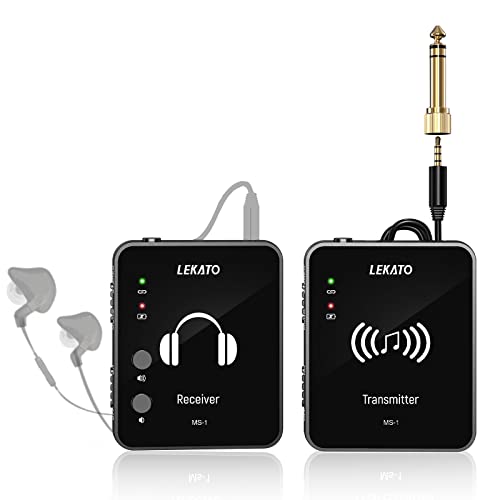
The LEKATO MS-1 provides true stereo audio transmission with an easy one-key switch between stereo and mono inputs. It uses a 2.4 GHz frequency band that supports up to 6 simultaneous sets without interference, suited for small to medium stage performances and rehearsals.
Featuring automatic pairing, the system requires no manual channel selection, simplifying setup for busy performers. Its wireless auto-pairing technology ensures devices connect swiftly, providing reliable and smooth frequency response with low latency.
Buying Guide For Wireless In-Ear Monitor Systems
Frequency Band And Interference
Wireless IEM systems operate on various frequency bands, commonly 2.4 GHz, 5.8 GHz, or UHF ranges. The 5.8 GHz systems offer less interference from other devices like Wi-Fi routers, whereas 2.4 GHz bands are more common but can face congestion in crowded RF environments. UHF systems usually provide longer range and better penetration but may require FCC licensing depending on location and frequency.
Latency And Audio Quality
Latency is a critical factor for live performance monitoring; values below 5 milliseconds are generally considered imperceptible and ideal for musicians. Look for systems with low latency wireless transmission and high sampling rates like 24-bit/48kHz for accurate and clear sound reproduction.
Battery Life And Portability
Long battery life supports uninterrupted performances and rehearsals. Systems offering between 5 to 8 hours of wireless operation are preferable. Rechargeable lithium batteries with charging cables enhance convenience. Additionally, compact transmitter designs and clip-on receivers improve portability and ease of use during mobile performances.
Receiver Compatibility And Multi-user Support
Consider systems that support one transmitter to multiple receivers if you have a band or crew needing simultaneous monitoring. Some options enable pairing up to 4 or 6 receivers effortlessly, saving signal management complexity.
Range And Signal Stability
Wireless range varies between systems; typical line-of-sight distances range from 90 ft up to 164 ft or more. Keep in mind physical obstacles such as walls and metal structures can reduce effective range. A system with solid diversity antenna technology and channel scanning features helps maintain signal stability.
Inputs And Output Options
Check for audio input compatibility such as XLR, TS, or TRS connectors for seamless integration with stage mixers or interfaces. Headphone jacks on transmitters or receivers allow direct monitoring. Systems supporting stereo transmission offer richer sound but might have different latency or channel requirements.
By assessing these factors, you can select a wireless in-ear monitor system that fits your specific performance, rehearsal, and studio needs effectively, ensuring high-quality sound and reliable wireless operation.