Transform your computer into a complete music workstation with a reliable USB to MIDI cable. This guide compares top options, highlighting ease of use, compatibility, and performance so you can pick the right interface for recording, editing, and playing with hardware keyboards, synths, and controllers. Each selection below supports common DAWs and operating systems, delivering low latency and straightforward setup for both beginners and experienced producers.
| Product | Brand | Key Benefit |
|---|---|---|
| TENINYU USB to MIDI Cable Converter 2 in 1 | TENINYU | 16-channel capability; LED indicators; plug-and-play |
| FORE MIDI to USB Interface | FORE | 1-in/1-out; driverless plug & play; LED status indicators |
| NUOSIYA MIDI Cable 4.5FT | NUOSIYA | Wide OS compatibility; stable data transfer; clear MIDI in/out |
| CME U2MIDI Pro | CME | Advanced features; filter and mapper; broad OS support |
| LEKATO MIDI Cable USB C | LEKATO | Type-C interface; low latency; plug-and-play |
TENINYU USB to MIDI Cable Converter
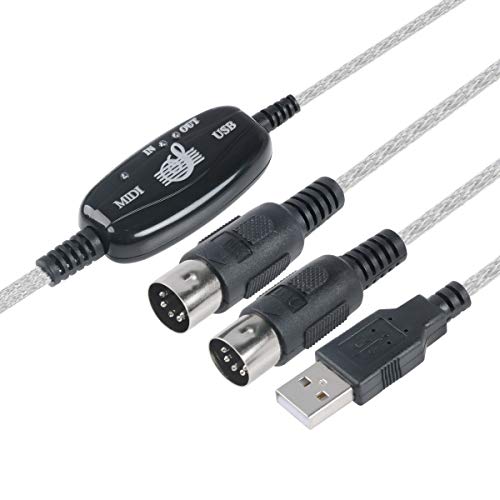
TENINYU offers a 2-in-1 USB MIDI setup that turns a PC into a music studio. By connecting an electronic instrument to a computer, users can record while playing, overdub additional tracks, and edit or print sheet music with compatible software. The adapter provides MIDI in and out cables along with a USB PC interface, and it supports up to sixteen channels in and out. LED indicators show power and signal activity for quick troubleshooting.
FORE MIDI to USB Interface

FORE’s 1-in/1-out MIDI interface supports 16 MIDI channels and works with keyboards, synthesizers, and other MIDI devices. It emphasizes plug-and-play setup with built-in drivers and LED indicators to show power and data transfer. The device is described as having low latency and broad compatibility with software like GarageBand, FL Studio, Cubase, and more, making it suitable for home studios and on-the-go setups.
NUOSIYA USB to MIDI Cable 6.5Ft

NUOSIYA’s USB to MIDI cable offers a 6.5-foot connection for flexible layouts. It provides a 1-in/1-out MIDI interface with 16 channels, designed for reliable data transfer and high-fidelity recording. The product notes emphasize compatibility with Windows and Mac systems, and an optional USB-C adapter is recommended for mobile devices. It is positioned as a cost-effective option for keyboards and other MIDI instruments used with computers or recording hardware.
CME U2MIDI Pro

CME’s U2MIDI Pro highlights professional-grade features, including a filter and mapper for flexible routing. It is a USB MIDI cable (1-in/1-out) with 16 channels and broad compatibility across macOS, iOS, Windows, Android, Linux, and more. The product is backed by CME’s support network and promises lifetime updates, making it suitable for users seeking long-term stability and advanced control over MIDI data paths.
LEKATO MIDI Cable USB C

LEKATO’s USB-C MIDI cable provides a 1-in/1-out interface with indicators to simplify troubleshooting. It supports up to 16 channels and emphasizes low latency and stable transmission. The driver-free, plug-and-play design makes it compatible with Windows and macOS, and its Type-C connector suits modern laptops and mobile devices that rely on USB-C for MIDI connections.
Buying Guide: Key Considerations For Choosing A USB To MIDI Cable
- Compatibility: Check operating system support (Windows, macOS, Linux, iOS, Android) and whether drivers are required. If you use an iPad or newer laptops, a USB-C interface may be crucial.
- Channels and Latency: Look for cables that support 16 channels (1-in/1-out) for standard setups. Low latency ensures tighter timing for recording and live playing.
- Plug-and-Play vs Drivers: Some models are truly plug-and-play, while others offer built-in drivers or optional software. Consider your DAW and workflow preferences.
- Indicators and Troubleshooting: LED indicators help verify power and signal transfer. Clear indicators reduce setup time and troubleshooting.
- Build Quality and Length: Cable length (6.5 ft common) provides flexibility in studio layouts. Durable connectors reduce wear over time.
- Cost vs Features: Compare features like mapping, filtering, or multi-channel support against your needs. Higher-end models may add professional routing tools.
- Device Compatibility: While most MIDI keyboards and synths work, some legacy devices may require adapters or adapters for audio output compatibility.