Choosing the right near-field monitors can make a measurable difference in music production. This guide highlights five reliable desktop studio monitors that balance accuracy, clarity, and value for home studios, hobbyists, and aspiring professionals. Each model offers distinct strengths—from tight bass in compact designs to convenient connectivity and built-in tone shaping. The selections below emphasize neutral sound and practical features for critical listening, mixing, and reference playback.
| Product | Brand | Key Strength | Featured Input/Tech |
|---|---|---|---|
| PreSonus Eris 3.5 Studio Monitors | PreSonus | Compact, accurate near-field monitoring | 50W Class AB, dual amplification |
| Mackie CR3.5 Creative Reference | Mackie | Tone knob for on-the-fly shaping | TRS/RCA inputs, 3.5mm, headphone out |
| Ortizan C7 Dual-Mode (White) | Ortizan | Wireless and wired versatility | BT 5.3, USB/aux |
| M-AUDIO BX3 | M-AUDIO | High-power 120W for detailed sound | Kevlar woofer, silk dome tweeter |
| Sanyun SW208 | Sanyun | Budget-friendly HiFi bookshelf monitors | Bluetooth 5.0, built-in 24bit DAC |
Note: This article focuses on five models chosen for relevance to music production, desktop use, and near-field listening. All product details come from the provided feature lists and product pages.
PreSonus Eris 3.5 Studio Monitors (Pair)

PreSonus Eris 3.5 near-field studio monitors deliver studio-quality, accurate sound suitable for music production, hi-fi listening, or multimedia reference. The 3.5″ woven-composite woofers provide a tight bass response with a clean overall sound, while dual 25W Class AB amplification per speaker supplies ample volume without sacrificing tonal balance. These compact monitors are designed for desktop setups where space is at a premium, making them a popular choice for home studios and small rooms. Their honest, accurate output helps producers gauge mix decisions with confidence.
Mackie CR3.5 Creative Reference Monitors

Mackie CR3.5 Creative Reference Monitors blend studio-grade sound with a built-in tone knob and flexible inputs, making them versatile for music production, gaming, and casual listening. The tone knob lets users boost bass or add brightness to suit different content and room acoustics, while TRS, RCA, and 3.5 mm inputs enable easy connectivity to audio interfaces, PCs, consoles, and portable devices. A built-in headphone output adds another layer of convenience for quiet monitoring or late-night sessions.
Ortizan C7 Dual-Mode Studio Monitors
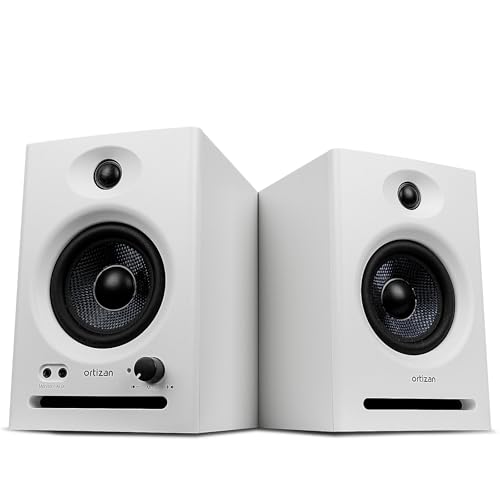
Ortizan C7 provides dual-mode operation with wired and Bluetooth 5.3 wireless connectivity, supporting versatile placement and use cases from desktop music production to casual listening and gaming. The system features a 3.5-inch mid-bass driver with a 0.75-inch silk-dome tweeter for balanced highs and mids, plus a USB DAC for improved digital audio fidelity. The two-way crossover design helps deliver clear, detailed sound across frequencies, aiding accurate monitoring in compact spaces where wires can clutter a setup.
M-AUDIO BX3 Studio Monitors

M-AUDIO BX3 monitors deliver 120 watts of powered studio sound, suitable for music production, podcasting, and multimedia creation. The design uses an acoustically inert MDF cabinet with a bass-reflex design and 3.5″ Kevlar low-frequency drivers paired with 1″ natural silk dome tweeters. A computer-optimized tweeter waveguide and rear ports support precise imaging and extended bass response, with high and low EQ options to dial in the ideal balance for different tracks and room acoustics. These monitors aim to provide studio-grade accuracy at a compelling value.
Sanyun SW208 3″ Active Bluetooth Bookshelf Speakers

Sanyun SW208 offers compact 2.0 bookshelf speakers with a 60W total system power and carbon fiber speaker units. A built-in 24-bit DAC and Bluetooth 5.0 provide flexible digital connectivity and high-fidelity sound for desktop music production, gaming, or everyday listening. The design supports both direct wired connections and wireless playback, delivering a solid stereo image in small spaces while maintaining clarity across the mid and high frequencies and delivering a controlled low end.
Buying Guide: Key Purchase Considerations
- Room size and monitoring distance: Near-field monitors are best for desks within 3–6 feet of the listener. Larger spaces may benefit from monitors with extended bass response and higher SPL headroom.
- Accuracy vs. color: For music production, prioritize monitors with flat frequency response and minimal tonal coloration. Some models offer tone controls or EQ to adapt to room acoustics, but aim to keep a neutral baseline.
- Connectivity: Check input options (TRS, RCA, 3.5 mm, Bluetooth) and ensure compatibility with your audio interface, computer, or mixer. A headphone output is useful for silent sessions.
- Built-in DSP and DAC: Monitors with integrated DACs and digital processing can simplify setup and improve signal integrity, especially when feeding digital sources directly.
- Cabinet build and bass management: MDF enclosures and ported designs influence resonance and bass extension. A front-ported or rear-ported design can affect placement near walls.
- Power and headroom: Look for sufficient wattage to deliver clean headroom at your typical mix levels. Class AB amplification generally balances efficiency and fidelity for desktop use.
- Budget vs. need: If you mainly mix hip-hop, EDM, or bass-rich genres, you may prioritize bass extension and output. For critical listening, accuracy and imaging often take priority over sheer loudness.
- Longevity and warranty: Consider build quality, availability of replacement parts, and manufacturer support when building a long-term studio setup.
- Future-proofing: If your rig may grow, select monitors with scalable inputs and room to upgrade with a subwoofer or additional channels.
These considerations help compare the five recommended models and understand how each might fit a specific workflow, room, and budget. The goal is objective, repeatable listening accuracy that informs mixing decisions without introducing excessive coloration.