Monocrystalline solar panels are renowned for high efficiency and strong performance in varied conditions, making them a popular choice for RVs, boats, cabins, and off-grid setups. This article highlights five well-regarded options from reputable brands, with a concise buying guide to help you compare features such as cell technology, durability, and shade tolerance. Each panel is evaluated for everyday reliability, maintenance needs, and suitability for 12V and 24V systems. Explore these selections to find a solution that fits your power needs and space constraints.
Summary of Selected Products
| Product | Brand | Panel Type | Approx. Power | Key Benefit |
|---|---|---|---|---|
| ECO-WORTHY 400W Panels (4x 100W) | ECO-WORTHY | Monocrystalline | 400W total | High daily output with low-light performance |
| STAR 870W Set (2x 435W) | STAR | Monocrystalline | 870W total | Full-screen design, maintenance-free |
| ECO-WORTHY 200W Kit (12/24V) | ECO-WORTHY | Monocrystalline | 200W | Integrated PWM charge controller, versatile for off-grid |
| Renogy 200W N-Type | Renogy | Monocrystalline | 200W | Compact size, high efficiency |
| Callsun N-Type 400W (2Pcs 200W) | Callsun | Monocrystalline | 400W | Bifacial design, anti-shade tech |
ECO-WORTHY 400W Monocrystalline Panels

The ECO-WORTHY 400W module set consists of four 100W panels fabricated with mono-crystalline cells and PERC technology. Each panel provides enhanced efficiency up to 23%, due in part to improved light reflection and cell design. A waterproof IP65 junction box with bypass diodes helps minimize power losses in shaded conditions, supporting dependable output for 12V and 24V battery charging in off-grid, on-grid, or hybrid systems. The cables extend 35 inches, enabling flexible installation on RVs, boats, sheds, or gardens. This kit emphasizes DIY compatibility and system expansion for growing solar setups.
Key considerations for this option include its high daily output potential under favorable sunlight, the inclusion of PERC technology for efficiency, and the practical benefit of built-in shade tolerance. While installation space and routing are factors, the modular 4x100W design supports scalable power as needs evolve. The IP65-rated junction box and pre-installed bypass diodes add reliability in outdoor environments, and the kit’s compatibility with 12V/24V systems makes it versatile for a range of vehicles and homes.
STAR 870W Solar Panels Set
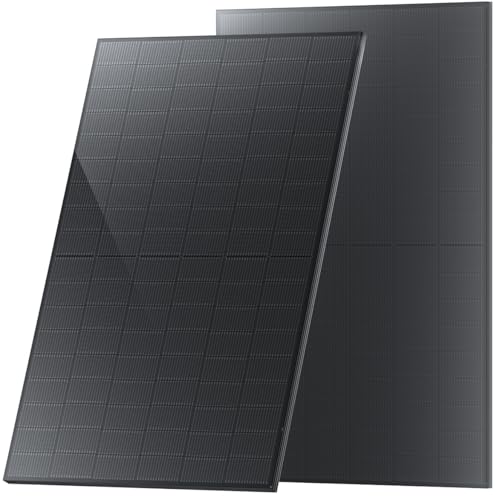
The STAR system offers a high-capacity solution with two 435W monocrystalline panels, delivering a robust 870W total in a frameless, full-screen design. This configuration is designed to minimize dust and water buildup, with a rain self-cleaning effect reducing maintenance. The panels boast 25% cell efficiency and carry certifications including ETL, ISO9001, CE, and patent protections. The design emphasizes stable power output in challenging weather and a power boost through the frameless construction, limiting obstructions and potentially increasing energy harvest by about 15% compared with conventional frames.
When evaluating this option, buyers should consider the orientation and mounting requirements for maximum sun exposure, as well as the networking capability if integrating with other panels. The full-screen, frameless approach can enhance lightweight installations but may require careful edge protection in windy areas. With high efficiency and strong certifications, these panels suit RVs, marine applications, and off-grid homes needing a high-output, maintenance-light solution.
ECO-WORTHY 200W Monocrystalline Kit

This ECO-WORTHY 200W kit pairs a high-efficiency mono-crystalline panel with a 30A PWM charge controller, aimed at RVs, campers, boats, and other off-grid needs. The kit notes daily outputs around 800Wh under four hours of sun, making it suitable for smaller power budgets and lighter loads. It uses a corrosion-resistant aluminum frame designed for decades of outdoor use and is rated IP65 for weatherproofing. The kit’s compact size and integrated controller simplify setup, enabling a quick path to a reliable off-grid charging solution.
Considerations for this kit include the balance between panel size, controller capacity, and your typical energy usage. PWM controllers are efficient for basic camping and RV loads but may require upsizing if you anticipate higher peak draws. The IP65 rating and durable frame provide confidence for outdoor deployments, while the higher efficiency mono-crystalline cells contribute to solid daily performance even in less-than-ideal conditions.
Renogy 200W N-Type Panel

The Renogy 200W N-Type solar panel uses 25% efficient N-type cells in a compact 24V system-oriented design. The smaller size (7.5% lighter and 11.7% smaller than prior models) makes it well-suited for tight spaces in Class B vans, roof installations, or small cabins. The 24V configuration reduces current through the system, which can improve overall efficiency and wiring practicality. Compatibility with 12V and 24V batteries adds installation flexibility, and the 16BB busbar configuration supports improved reliability and reduced microcracking risks, particularly under thermal stress.
Key decision factors include space availability, mounting constraints, and whether a 12V or 24V system is preferred. While Renogy emphasizes compact form and efficiency, users should ensure the panel’s dimensions fit their mounting area and that the chosen charge controller aligns with the system’s voltage and amperage requirements. The panel’s durable construction and high-efficiency cells help maximize daily energy yields in mobile or stationary setups.
Callsun N-Type 400W Dual-Module

The Callsun N-Type 400W set features two 200W modules with bifacial design that captures light from both sides, potentially increasing total output by up to 30%. Their anti-shade, TwinCell technology helps reduce voltage drops when portions of the panel are shaded, improving reliability in environments with partial sun exposure. The N-type cells offer higher efficiency and reduced microcrack risk compared to traditional P-type designs. This setup is well-suited for RVs, vans, or home rooftops where shading is a concern and energy density matters.
When considering Callsun, evaluate your typical sun path, shading patterns, and whether the bifacial advantage justifies panel mounting on a surface that can reflect light to the rear of the panel. The dual-module approach also provides flexibility in wiring configurations, supporting series or parallel connections to match voltage and charge controller capabilities.
Buying Guide: Key Purchase Considerations
- Power needs and system voltage: Determine whether you operate on 12V or 24V systems and estimate daily energy requirements (Wh/day). Higher-wattage panels reduce the number of panels needed but may require a larger mounting area and higher-rated controllers.
- Panel efficiency and cell type: Monocrystalline panels, especially those with PERC or N-type cells, offer higher efficiency and better performance in low light or high-temperature conditions, but may come at a higher price.
- Durability and weather resistance: Look for corrosion-resistant frames, IP ratings on junction boxes, bypass diodes for shading tolerance, and overall build quality suitable for outdoor exposure (wind, snow, rain).
- Shade tolerance and layout: Shading from trees, buildings, or other structures can dramatically reduce output. Technologies such as bypass diodes, multi-busbar designs, and bifacial backsheets help mitigate losses.
- Installation and mounting: Consider physical dimensions, weight, mounting hardware compatibility, and whether the panels are frameless or framed. Framed panels are typically easier to handle and mount, while frameless designs save space and weight but may require edge protection.
- Electrical integration: Ensure compatibility with charge controllers (PWM vs MPPT), inverters, and battery banks. MPPT controllers maximize energy harvest, especially in fluctuating conditions, but add cost.
- Maintenance and warranties: Review warranty terms for workmanship, performance (often a 25-year linear warranty), and degradation rates. Check for certifications (ETL, CE, ISO) that indicate quality control standards.
- Scalability: If you anticipate expanding your system later, choose panels that easily integrate with additional modules and compatible controllers to minimize future changes.