Choosing the right mixing studio monitors is essential for accurate music production, video post, and gaming audio work. This guide highlights five solid options that balance clarity, bass response, and room-fit for near-field desktop setups. Each pick emphasizes honest, repeatable sound so you can trust your mixes across headphones and other playback. Whether you’re building a home studio, upgrading your workspace, or refining your mixing workflow, these monitors offer reliable performance without excessive cost.
Below is a quick summary of the selected products to help you compare at a glance. The table includes the product name, brand, and a snapshot of key features to expect from each model.
- PreSonus Eris 3.5 Studio Monitors (Black) — 50 W total, near-field accuracy, compact footprint
- Ortizan C7 Dual-Mode Studio Monitors (White) — 2.0 setup, Bluetooth 5.3, multiple inputs
- Ortizan C7 Dual-Mode Studio Monitors (Black) — 2.0 setup, Bluetooth 5.3, multiple inputs
- Mackie CR3.5 Creative Reference Monitors — tone control, TRS and RCA inputs
- PreSonus Eris 5BT Bluetooth Studio Monitors — 100 W total, Bluetooth, near-field design
PreSonus Eris 3.5 Studio Monitors, Pair

HONEST. Eris 3.5 near field studio monitors deliver studio-quality, accurate sound ideal for music production, hi-fi listening, or multimedia reference. EXPRESSIVE. Clear, accurate audio with a substantial low end thanks to woven-composite woofers, delivering tight bass you can feel without muddiness. POWERFUL. Compact design with 50 watts of Class AB dual amplification (25W per side) maintains tonal balance and clarity even at higher listening levels.
Ortizan C7 Dual-Mode White Studio Monitors
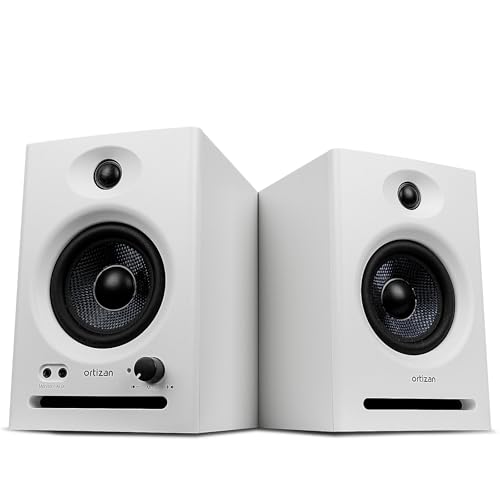
MULTIPLE INPUTS. RCA for wired connections and BT 5.3 for quick wireless pairing, along with a 3.5 mm aux to connect almost any device. HIFI BOOKSHELF SPEAKERS. Built-in 24-bit DAC enables direct USB audio capture with minimal conversion loss, delivering accurate monitoring fidelity. 3.5-inch carbon fiber woofer and 0.75-inch silk-dome tweeter provide precise mid-low to high-frequency response, supported by an electronic 2-way crossover for a layered sound stage.
Ortizan C7 Dual-Mode Black Studio Monitors

MULTIPLE INPUTS. RCA and Bluetooth 5.3 provide flexible wired and wireless connections. 3.5 mm AUX adapts to devices with headsets or line-level outputs. HIFI BOOKSHELF SPEAKERS. The built-in 24-bit DAC ensures low-latency, high-fidelity sound during audio production. 3.5-inch carbon fiber woofer with a 0.75-inch silk-dome tweeter yields a balanced, transparent voice with clear highs and controlled lows.
Mackie CR3.5 3.5″ Creative Reference Monitors

CREATIVE REFERENCE. Mackie CR3.5 combines studio-grade sound with a tone knob and a compact form factor suitable for desktops, gaming, and casual listening. CONNECTIVITY. TRS and RCA inputs allow compatibility with audio interfaces and playback devices; 3.5 mm input enables PC or console use. TONE KNOB. Shape bass and presence to suit gaming, films, or music, providing a flexible monitoring experience for a small workspace.
PreSonus Eris 5BT Bluetooth Studio Monitors

HONEST. Eris 5BT near field studio monitors deliver accurate studio-grade sound for production and multimedia reference. EXPRESSIVE. A strong low end with a clear midrange and smooth highs, thanks to woven-composite woofers and precise cabinet design. POWERFUL. 100 watts of Class AB dual amplification (50W per side) ensure ample headroom for critical listening and mixing in near-field setups, while maintaining tonal clarity.
Buying Guide
Key considerations when selecting mixing studio monitors for a desk setup:
- Room size and listening distance: Near-field monitors reduce reflections in small spaces, but room treatment can dramatically improve accuracy.
- Frequency response and tonal balance: Look for monitors that emphasize a flat or gently tailored response to avoid misleading bass boosts.
- Power and headroom: More watts can help in louder sessions without distortion, yet efficiency matters for small desks.
- Connectivity: Choose monitors with common interfaces (RCA, TRS, USB DAC, Bluetooth) that align with your audio source and workflow.
- Cabinet design and build: Solid, resonance-reducing enclosures help maintain clean highs and precise imaging.
- Docking and placement: Consider stands or isolation pads to minimize desk vibrations and improve imaging.
- Bluetooth versus wired: Bluetooth offers convenience but may introduce latency or color; wired connections are typically more transparent for mixing.
- Additional features: Tone controls, built-in DACs, and headphone outputs can add flexibility for late-night sessions.
In practice, the best choice depends on your room, workflow, and budget. If space is tight, smaller near-field models with solid bass extension can provide reliable reference without overwhelming the desk. For broader mixing tasks or multi-genre projects, monitors with higher wattage and a flat, transparent response help minimize room-induced coloration. Bluetooth-enabled models offer convenience for casual listening but may be less ideal for precise mixing due to potential latency and signal processing. Always audition monitors with your typical reference tracks and confirm imaging, stereo field, and low-frequency accuracy before purchase.
For effective long sessions, pair these monitors with proper desk isolation, acoustic treatment, and calibrated listening setups to maximize accuracy and reduce listener fatigue.