Photographers rely on accurate light meters to balance ambient and flash lighting, capture consistent exposures, and control color in a variety of settings. This guide highlights five dependable light meters suited for studio work, field shoots, and cinematography. Each option offers different features, from ambient-only readings to full ambient-plus-flash measurements, with user-friendly interfaces and durable designs for American photographers.
| Product | Brand | Key Strength |
|---|---|---|
| Sekonic L-308X-U Flashmate | Sekonic | Accurate ambient and flash readings, versatile Photo Mode |
| UNI-T UT383 | UNI-T | Wide Lux/FC range, compact and affordable |
| Sekonic LiteMaster Pro L-478D-U | Sekonic | Simultaneous ambient and flash measurements with cine modes |
| Mcbazel Digital Illuminance | Mcbazel | Very wide 0–200,000 Lux range with clear LCD |
| Sekonic FLASHMATE L-308X | Sekonic | Pocket-sized with broad EV and flash range |
Choosing the right light meter depends on whether you work primarily with ambient light, require flash metering, or need cine-specific features. The following sections review five carefully selected products, summarizing how they read light, their usability, and who benefits most from each model.
Sekonic L-308X-U Flashmate Light Meter

The L-308X-U provides exposures accurate to a tenth of a stop for ambient and flash readings in full-stop mode. At ISO 100, the ambient EV range spans 0 to 19.9, while flash f/stops range from f/1.0 to f/90.9. Its shutter-speed span covers 60 seconds to 1/8000 second for ambient readings and 1 second to 1/500th for flash. Photo Mode supports still photography with a display of ambient and flash functions, including corded and cordless flash measurements. This meter suits photographers needing compact accuracy with straightforward, quick readings for both light types.
UNI-T UT383 Light Meter Lux Meter

The UT383 measures light intensity from 0 to 199,900 Lux (0–18,500 FC) with high accuracy and a large backlit LCD. It displays readings in Lux or FC and offers Max/Min memory, data hold, and auto power-off. Its compact design and fast 0.5-second sampling support quick checks during location shoots or studio setups, making it a practical choice for photographers and hobbyists who value portability and clear results.
Mcbazel Digital Illuminance Light Meter

The Mcbazel meter provides a wide measuring range up to 200,000 Lux with accuracy claims of ±3% (≤10,000 Lux) and ±4% (>10,000 Lux). The device switches between Lux and FC units and features an easy-to-read LCD with a backlight. It supports quick sampling and is suitable for photography, horticulture, and indoor lighting applications where a broad, reliable range is essential, including plant growth environments and studio lighting checks.
Sekonic FLASHMATE L-308X

The FLASHMATE L-308X is a compact, pocket-sized tool for metering ambient and flash lighting. It includes a lumisphere for ambient measurements and a 40° reception angle for reflected light. Its metering range spans 0 to 19.9 EV at ISO 100, and it handles flash from f/1.0 to f/90.9 at ISO 100. This model is favored by photographers who need a small, reliable meter for on-the-go use across diverse lighting environments.
Sekonic LiteMaster Pro L-478D-U

The L-478D-U meter excels in setups where ambient and flash need simultaneous measurement. Its large color LCD presents ambient, flash, cine, and other information clearly, and it features two motion capture modes to fit various camera formats. The meter is especially valuable for balancing flash to reduce background detail or to smooth exposure in mixed lighting. It supports HD SLR and cine-style frame rates and shutter angles, providing versatility for stills and motion shoots.
Light Meter Digital Illuminance with 200k Lux Range
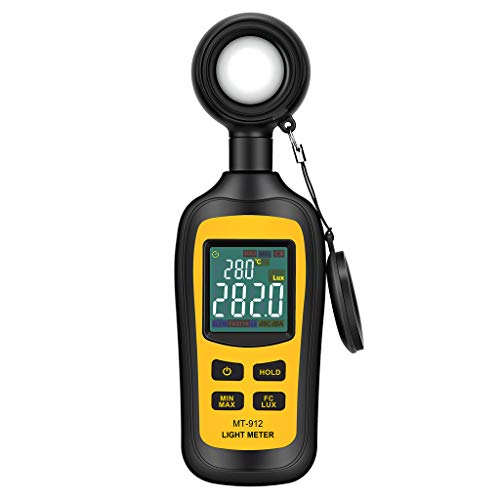
This meter provides a high-contrast 0 to 200,000 Lux range with three-digit accuracy indicators for reliable indoor and outdoor readings. It supports MIN/MAX data logging, auto power-off, and a rotating sensor to facilitate measurements from various angles. An affordable option for photographers and plant growers who need precise lux readings, especially in variable lighting environments.
Buying Guide: Key Purchase Considerations
- Measurement scope: Decide between ambient-only meters and combined ambient-plus-flash meters. If you frequently work with studio strobes or off-camera lighting, a meter that reads both ambient and flash will save time and reduce exposure guesswork.
- Display and usability: Look for large, clear LCDs, backlighting, and intuitive controls. Quick access to ambient vs. flash modes helps on busy shoots.
- Color and cine features: For video and cine work, meters with cine modes, shutter-angle readings, and frame-rate options can streamline exposure decisions on set.
- Range and accuracy: A wider EV or Lux/FC range is beneficial in high-contrast scenes. Check stated accuracy and consider meters with manual calibration options if you require precise validation.
- Portability: Pocket-sized meters are convenient for on-location work, while larger meters may offer more features and better ergonomics for studio setups.
- Power and durability: Battery life, auto-off settings, and build quality matter for field use. Water or dust resistance can help in challenging environments.
- Price and support: Compare features against price and review after-sales support, firmware updates, and available accessories like lumispheres or reflectors.
Across these options, the choice depends on whether the priority is compact form, broad measurement ranges, or cine-specific capabilities. For photographers who value fast, reliable ambient and flash readings in a compact package, the Sekonic L-308X-U and FLASHMATE L-308X offer familiar usability with strong performance. For studio and motion-focused workflows, the LiteMaster Pro L-478D-U provides advanced features and versatile metering modes. For budget-conscious users or those needing wide-range Lux readings, the Mcbazel and UNI-T UT383 present capable, user-friendly alternatives.