The following article reviews top four-channel headphone amplifiers popular with musicians, podcasters, classrooms, and small studios. Each option supports four independent headphone outputs, enabling multiple listeners to share a single audio source without sacrificing volume control or sound quality. This guide highlights what to look for, how each model performs, and practical considerations for selecting the right device for your setup.
| Product | Brand | Key Benefit | Output Type |
|---|---|---|---|
| LZSIG Headphone Amplifier | LZSIG | Ultra-low noise, independent volumes | 1/4″ & 1/8″ TRS |
| Mackie HM Series HM-4 | Mackie | Simple, reliable four-user monitoring | 1/4″ TRS |
| HA400 Behringer | Behringer | Compact with four independent controls | 1/4″ TRS |
| ART HeadAMP4 | ART | Low-noise, high fidelity | 1/8″ and 1/4″ inputs/outputs |
| Fifine N6 | FIFINE TECHNOLOGY | Four independent channels with robust build | 1/4″ TRS |
LZSIG Headphone Amplifier — 4 Channel
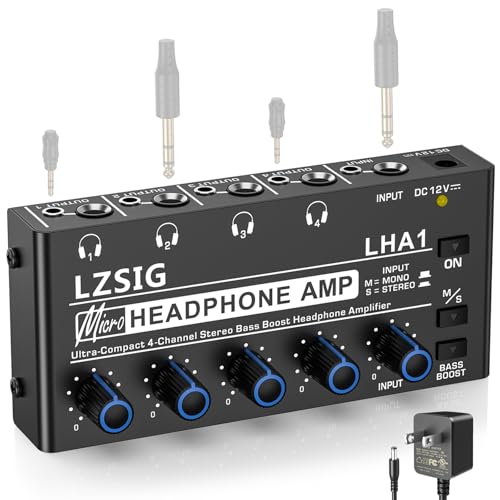
The LZSIG four-channel headphone amp delivers independent volume control per channel with ultra-low-noise output. It supports both 1/8″ (3.5 mm) and 1/4″ (6.35 mm) headphones, making it compatible with most studios and stage gear. The built-in bass boost enhances vocal presence and bass frequencies, useful for monitoring detailed mixes. The unit is designed to distribute up to four audio signals with minimal distortion, using Rohm-based op-amps for clean sound. It is suitable for studio or live environments where multiple listeners need to monitor simultaneously without cross-talk.
Key features include four independent outputs and a bass boost function that enhances specific frequency bands (400–600 Hz and 3000–7200 Hz). The device emphasizes low noise performance and compatibility with various plug types, including TS and TRS. It is a practical choice when you need a compact, four-channel distribution amp that maintains signal integrity across all outputs.
Mackie HM-4 4-Way Headphone Amplifier

The Mackie HM-4 is a compact 4-channel headphone mixer with four independent volume controls. It shares a single stereo source across four headphones, which is ideal for classroom setups, small studios, or collaborative projects. The HM-4 is powered via an included 12V AC adapter, ensuring stable operation even during extended sessions. Each output can be adjusted individually, helping users maintain consistent monitoring levels across listeners while preserving sound quality.
With simple front-panel controls and a reputation for reliability, the Mackie HM-4 emphasizes straightforward operation and solid build quality. It is well-suited to environments where ease-of-use is a priority, such as project studios or teaching spaces, while still delivering respectable audio performance for critical listening or mixing tasks.
Behringer MICROAMP HA400

The Behringer HA400 Ultra-Compact 4-Channel Headphone Amplifier distributes audio to four listeners with individual volume controls. The device employs ultra-low-noise 4580 operational amplifiers, providing clear, clean sound even at higher output levels. The compact form factor makes it easy to fit on crowded desks or portable setups. A dedicated 12-volt DC adapter is included to ensure stable power delivery for all four channels, making the HA400 a versatile choice for studios, rehearsal spaces, and live monitoring tasks.
Users benefit from independent volume control per channel, enabling each listener to tailor their mix. The HA400 is compatible with a wide range of headphones, and its affordable price point makes it a popular option for budget-conscious rooms. It’s a practical solution for small ensembles or home studios that require multi-headphone monitoring without complex routing or software control.
ART HeadAMP4 Eight Output Stereo Headphone Amplifier

The ART HeadAMP4 is designed to provide eight outputs from a four-channel source, effectively giving four independent stereo pairs. It supports both 1/8-inch and 1/4-inch inputs and outputs and emphasizes lower noise and distortion. The 4-channel architecture with independent volume control per channel makes it a robust option for stage or studio environments where multiple performers or technicians need reliable headphone monitoring. The HeadAMP4 is built for musicians and engineers who require consistent audio quality across multiple listeners during practice sessions or performances.
ART concentrates on delivering high-fidelity audio with minimal interference, making it suitable for studios, rehearsal rooms, and live settings. While slightly larger than ultra-compact units, it offers scalable monitoring capacity without compromising sound. The device’s emphasis on low noise and sufficient headroom helps maintain accurate mixes when several listeners are connected.
FIFINE N6 Headphone Amplifier
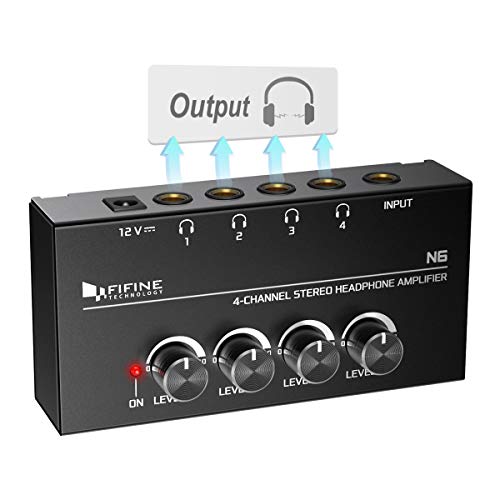
The FIFINE N6 offers four independent channels with separate volume controls per output, designed for shared monitoring in studios, live performances, or home entertainment setups. It uses 1/4″ TRS for both input and output, supporting balanced connections that help minimize noise in crowded signal paths. The compact metal construction ensures durability while remaining portable for on-the-go sessions. The N6 is especially noted for maintaining signal integrity when all four outputs are active, reducing audible crackle and distortion during high-volume monitoring.
This model emphasizes robust build quality and practical portability, making it a solid choice for small venues, broadcast setups, or teaching studios. The included guidance on using the 1/4″ TRS connections helps users avoid mis-wiring while maximizing compatibility with common audio interfaces and mixers. Overall, the FIFINE N6 is a reliable, four-channel companion for shared listening tasks where consistency and control matter.
Buying Guide: Key Purchase Considerations For 4-Channel Headphone Amplifiers
When selecting a four-channel headphone amplifier, several factors influence long-term satisfaction and performance. Consider the following perspectives to choose the best fit for your needs:
- Output quality and noise: Look for units that emphasize low-noise op-amps and sufficient headroom to avoid distortion at higher volumes. Ultra-low-noise designs help preserve the clarity of nuanced mixes when multiple listeners monitor simultaneously.
- Independent channel control: Ensure each channel has its own volume control. This is essential for balanced monitoring across listeners, particularly in recording studios or group practice spaces.
- Impedance and compatibility: Check headphone impedance support (commonly 32–100 ohms). Many amplifiers handle a range but confirm compatibility with your headphone inventory to avoid under- or over-driving drivers.
- Inputs and outputs: Verify TRS and TS compatibility, including both input and output jacks. Some units offer 1/8″ optional connections; ensure the device matches your existing cabling and gear (mixers, audio interfaces, stage monitors).
- Power delivery: Consider PSU requirements. Some models include a dedicated 12V adapter, which stabilizes performance during heavy use. Portability may require AC adapters or compact power options.
- Ruggedness and portability: For mobile setups or on-the-road use, choose metal enclosures and compact footprints. Robust builds reduce wear over time and protect delicate electronics.
- Use case and environment: Classify whether you need monitoring for recording, live sound, classrooms, or home studios. Some units excel at sharing a single stereo source, while others emphasize multi-user monitoring in live or rehearsal spaces.
- Budget and value: While prices vary, prioritize devices that offer independent level control, clear audio with minimal noise, and durable construction. A balance between price and core features typically yields the best long-term value.
In sum, a four-channel headphone amplifier should deliver clean, controllable monitoring for all connected listeners, with reliable power, durable construction, and straightforward operation. By assessing impedance compatibility, independent controls, noise performance, and connectivity, you can identify the model that best supports your recording, rehearsal, or education needs.